Archive for the ‘Tools’ Category
 |
28. September 2012 – 15:25 by John Heaven (TuTech Innovation GmbH)
|
The invisible man
Today we held the second of two Google+ Hangouts with PEP-NET members. No real agenda, open to anyone who was interested, and not quite sure whether it would work. We gave it a go.
From an organiser’s point of view, the best things about doing a hangout rather than a text-based live chat (as we have done before with CoverItLive) is that i) the number of participants doesn’t need to be high for you to feel successful and ii) you can really see who is there and know that people were there for the duration. If I had organised a live text chat and six people in total had taken part, I would have been pretty disappointed.
Rather than writing boring minutes of the conversation, here is a collection of links to projects that were mentioned, as well as the websites or twitter accounts of the participants themselves. After all, it’s the taking part that counts, not the minutes.
Finland: Youth Initiative Channel, a project allowing youngsters to make suggestions/express wishes. Similar to FixMyStreet but about solutions, not problems.
(Some information in 2.3.1. of this report (PDF)), via @nadinekarbach.
Iceland: A group of citizens drafted a new constitution using online collaboration tools and presented it to the speaker of the parliament. Here’s a link that I found about the story, via @nadinekarbach (again)
Finland: The Finnish children’s parliament, via @nadinekarbach. (Now I feel like a kid copying someone else’s homework. Thanks Nadine.)
UK: 38 Degrees: a platform that brings people together to campaign, via @andywilliamson
The Danish Parliament puts videos of all its sessions online, and has made them fully searchable by users. Here’s an article I found about that. Thanks again, @andywilliamson
Participants:
Gábor Mihucz (Foundation for Societal Participation, Germany/Hungary), @GaborMihucz
Nadine Karbach (YouthPart, Germany), @nadinekarbach
Andy Williamson (FutureDigital, UK/worldwide), @Andy_Williamson
Hans Hagedorn (DEMOS eParticipation, Germany), @haans_en
Rolf Lührs (TuTech/DEMOS eParticipation, Germany), @somed
Peter Sonntagbauer (FUPOL), fupol.eu
… and of course me, @johnheaven
And PEP-NET is @pepnet.
Posted in Events, members, Tools | No Comments »
|
|
17. September 2012 – 13:49 by John Heaven (TuTech Innovation GmbH)
|
Every year, Bearing Point and Cisco Germany award a project the title of “the most innovative e-government project in the German-speaking world”. This year, the Federal State of Schleswig-Holstein was nominated for their project BOB-SH* in which they implemented DEMOS-Plan, our software for managing spatial planning consultations online. And they won!
So we’ve been feeling a little bit innovative for the past week too. After all, we worked closely with Schleswig-Holstein, giving technical support, training and telephone assistance to the wide range of stakeholders who will be working with DEMOS-Plan.
DEMOS-Plan is an online tool that closely follows the procedure laid down by German law for conducting consultations on a particular type of spatial plan (the “Bebauungsplan”). It allows statutory stakeholders to manage submissions internally by requiring one representative to sign off the submissions from different departments. These submissions can be linked to a particular paragraph of the planning document and/or the participant can draw on a map of the plan.
It’s great for the planning authority, because it saves them the trouble of sending paper copies of plans and collating all the submissions manually: instead, this is done automatically.
We think there are other countries in Europe where DEMOS-Plan could be useful and have been investigating this through the Parterre project. If you were at the PEP-NET Summit, you may have caught Francesco Molinari’s presentation of Parterre. (Hopefully you will also have noticed that the Summit was sponsored by Parterre!)
There will be more news on Parterre soon, so keep your eyes on the blog!
* Bauleitplanung Online-Beteiligung Schleswig Holstein
Posted in good practice, ICT, members, News, Tools, TuTech | No Comments »
 |
8. August 2012 – 12:23 by Zebralog
|

/Please note: This post is not from Hans Hagedorn, but from Steffen Albrecht @ Zebralog – Hans’ avatar is displayed because of a malfunction of PEP-NET’s profile function – we’ll try to fix this…/
Get involved in the latest developments of eParticipation tools!
Policy analysts, decision makers as well as civil society stakeholders and other people interested in policy-making all have to cope with numerous arguments brought forward in policy debates. The EU-sponsored IMPACT project develops open source online tools that help to make sense of the range of opinions about public policies expressed in policy consultations.
In a series of webinars, four new prototype tools will be presented, followed by an evaluation of the tools in which participants can discuss further improvements and the potential impact of the tools on policy-making. Based on material from the EU’s consultation on the Green Paper on Copyright in the Knowledge Economy, the participants will learn how to formalise and visualise arguments, how to estimate the effects of policy proposals with the help of policy modelling, and how opinions about arguments are assessed with the help of structured consultations.
We invite all PEP-NET members and readers of this blog to participate!
Please register for one of the following dates on this website:
https://policy-argumentation.posterous.com/webinar-new-online-tools-to-support-argumenta
The following dates are available:
Webinar with focus on argument reconstruction & visualization:
- 21 August 2012, 11:00–12:00 CEST (Tuesday morning)
- 23 August 2012, 16:00–17:00 CEST (Thursday afternoon)
Webinar with focus on policy modelling & structured consultation:
- 28 August 2012, 16:00–17:00 CEST (Tuesday afternoon)
- 29 August 2012, 11:00–12:00 CEST (Wednesday morning)
Further information is available here. If you have any questions, please contact Steffen Albrecht: impact@zebralog.de
Posted in Events, Projects, Tools | 1 Comment »
 |
22. May 2012 – 10:09 by Asociacion Ciudades Kyosei / Pedro Prieto-Martin
|
 This week Avaaz, the “campaigning community bringing people-powered politics to decision-makers worldwide’, started the beta-testing of its community petitions platform, which allows anybody to launch a petition in a question of minutes. This new systems empowers anybody to make use of the streamlined processes and tools that have allowed Avaaz to grow its user base to more than 14.400.000.
 Avaaz thus follows the recente move from change.org, the “social action platform that empowers anyone”, which just two weeks ago ‘absorved’ the Spanish platform “Actuable” and is now planning to translate its ‘petition making system’ to many other languages to really extend its reach worldwide.

Each of these platforms claims to have promoted petitions that forced very important political ‘actors’ to react: from Hillary Clinton to Presidente Morales, from Bank of America and Apple to Hilton Hotels.
 This is an interesting ‘tectonic’ move in the realm of (e)Participation, which we should follow closely. It is, additionally, much related to the discussion about “Sticks and Carrots” we hold in Pep-Net’s blog a year ago.
We were then reflecting about questions like: is it better to praise “good deeds” of Corporation and Politicians, or is it better to warn and punish them when they “misbehave”? Why not both things at the same time?
Anita Roddick, the founder of the Body Shop, reported that once an executive of Shell told her: “We don’t fear regulation, we only fear consumer revolt”
Well: it is clear now that consumer and citizens are getting better at revolting and exerting pressure. Change is happening out of anybody’s reach, and (e)Participation is slowly “getting teeth”, which soon will be able to hurt enough as to influence behaviour: if you do not want your brand reputation to get ruined… you better behave!!! And this applies to corporation as much as political actors.
The promise of a ‘Future Goverment’ that becomes FAST (flatter, agile, streamlined and tech-enabled) -which was delivered in the last World Economic Forum- starts to be truth. But, for sure, it is not government who is promoting it. It is NGOs and CSOs. It is citizens.
It is important to note that the technology behind these petition plattforms is very, very simple. The concepts and processes of use are also not sci-fiction. But for sure, this kind of powerful, sustainable and social minded (e)Participation was rarely promoted by our Governments’ Innovation Support Actions. Instead of an impact oriented eParticipation research, put at the service of Civil Society, a Government- and Academia-centred approach was preferred. And thus eParticipation has just advance by little steps.
It is a pitty, because these platforms are now out there, growing. They were created with less (or ‘no’) involvement of eParticipation researchers. And that means that we do not have easy access to the very valuable information about eParticipation that these systems are generating (about pattern and reasons of use, users’ demographics, typologies of action, success rates, etc).
We should reflect about this. We have not so many more opportunities to miss. The field is developing faster and faster. Do we want to be part of it?
Posted in good practice, ICT, inclusion, Tools, Trends, Visions | No Comments »
 |
17. April 2012 – 09:08 by Fraser Henderson - ICELE
|

A new digital engagement database is launched today by ParticiTech and Kind of Digital in association with Consumer Focus (UK).
Digitalengagement.org is different from other digital engagement databases in that it is a methods repository, not case study database. The website also doubles as a search engine, allowing methods to be matched based on a set of simple input criteria relating to the participation characteristics.
Give it a whirl and let me know what you think!
Read the full press release here
Posted in good practice, Projects, Tools | No Comments »
|
|
14. November 2011 – 23:06 by Asociacion Ciudades Kyosei / Pedro Prieto-Martin
|
The Asociación Ciudades Kyosei is a small civic organization whose aim is to foster Civic Engagement by means of ICT. It was founded in 2006 and is the oldest Spanish NGO devoted to the promotion of (e)Participation. In the last years we were researching on the field of Civic Engagement and ICT, with a special focus on Latin-America and Europe. Our work combines a critical attitude with an applied, hands-on focus, and has (1) theorized about Civic Engagement, (2) analysed the best design practices for (e)Participation systems, as well as (3) analysed the difficulties that exist to promote innovation in the ICT for Governance field. Our research has been widely recognized as refreshing and insightful.
In this PeP-NET post we would like to share a tool we have developed, “The matrix of civic implication”, whose main aim is to support the development of conceptual clarity when analyzing participatory venues and participatory initiatives. If used wisely, we think the matrix is a powerful “tool”, that goes beyond alternative models (like OECD, IAP2 or Fung’s), and should allow researchers, practitioners and the ‘man in the street’ to better understand the core dimensions of participatory activities.
The Matrix of Civic Implication
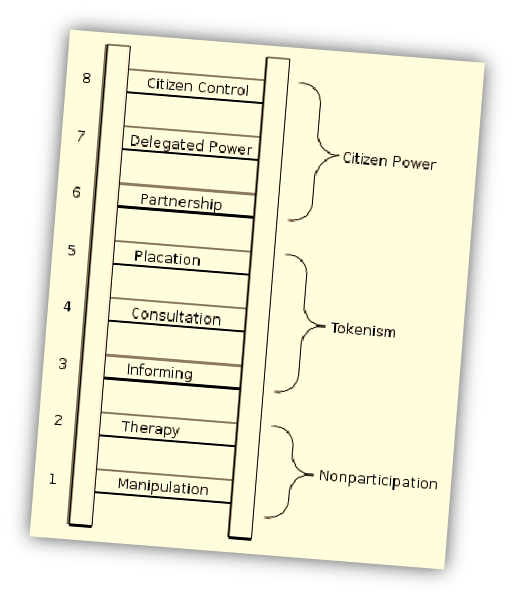
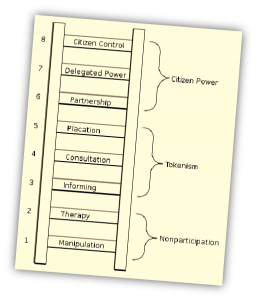 Since Sherry Arnstein presented her “Ladder of Citizen Participation” in 1969, tens of models have been proposed with the aim to describe “participation”.
The problem with these models is that they tend to be either too basic -and thus they add less value- or they are too complex and specialized, and in this case they are too cumbersome to be applied.
For this reason… a lot of confusion exist in this field.
Our matrix tries to find a pragmatic balance between usefulness and complexity, and provide a tool that is at the same time powerful, practical and easy to use. It allows practitioners and theorists to compare in a matter of minutes different Participatory experiences. The model was developed to be applied to “municipal participation” initiatives, but it can be applied to other kind of participatory experiences.
The Matrix identifies four fundamental dimensions of participatory initiatives, which be informally “visualized”, and thus make this model especially suitable for comparing initiatives:
Read the rest of this entry »
Posted in open data, Tools, Visions | 1 Comment »
|
|
7. September 2011 – 10:33 by Fraser Henderson - ICELE
|
 The Consultation Institute (TCI) have launched what they believe to be the first quality scheme for public engagement software. Software vendors can apply for their tool to be tested against the principals of the TCI consultation charter which is a set of good practices. Assurances are also sought from existing customers and the package of training, support and help are scrutinised.
This results in a test report, including actions and recommendations for product development enhancement generated by experts in eParticipation. Software and services which meet a certain grade will be granted the use of a logo which can be used on all marketing materials as a sign of product confidence.
An announcement will be made on 29th September regarding the first vendor to achieve successful accreditation during the annual TCI ‘Technologies for public engagement and consultation event’ (London).
For enquiries, please email Fraser.henderson@btinternet.com
Posted in good practice, Tools | 2 Comments »
|
|
28. July 2011 – 16:49 by Asociacion Ciudades Kyosei / Pedro Prieto-Martin
|
“The e-(R)evolution will not be funded. An interdisciplinary and critical analysis of the developments and troubles of EU-funded eParticipation” is the title of a paper that our association recently wrote as part of our research and knowledge dissemination efforts. The article is meant to be properly published soon, but some bureaucratic issues have delayed its release more than we can wait.
Because this paper needs to be read and, more important, discussed while its analyses are still current.
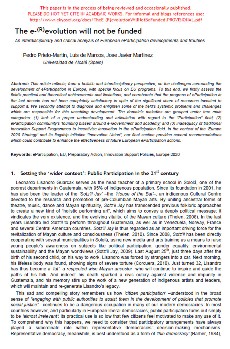 Thus, we have decided to make it provisionally available through PeP-NET. To start such a conversation, what better place than PeP-NET, the Pan European eParticipation network?
We have spent many hundreds of hours researching and writing the paper, as we struggled to make sense of the developments and “under-developments” of eParticipation in the last ten years.
Our appraisal is based on an extensive and interdisciplinary analysis of distinct relevant sources, which included the most recent reports, articles and literature reviews dealing with eParticipation research, practice and theory, as well as projects’ deliverables and evaluations, related databases, and our direct examination of eParticipation systems.
We had to resort to a very varied bunch of disciplines (from history and medicine to Mayan performing arts; seriously!! ) to be able to achieve a comprehensive understanding of the field’s challenges… and to make a compelling exposition of them.
The paper ended up being “quite controversial”, as our assessment of eParticipation came to suggest that some of the problems that have hampered its progress have a systemic, overarching character: that kind of ‘elephant in the living room’-issues whose very existence tends to be denied because of their complexity or the embarrassment they cause and, as a result, cannot normally be acknowledged or discussed, let alone get properly sorted out.
Examples of the “embarrassing questions” the paper poses are:
- How can it be that after 10 years… all relevant ‘agendas’ of eParticipation research are still reported as underdeveloped?
- And how can it be that even the most basic questions –for example: the relation of Participation and eParticipation, or the understanding of the dual nature of eParticipaton as something that can be driven by authorities or by citizens themselves– remain unsolved?
- More than 187 millions of Euros were invested in the last ten years to promote experimentation in the field, so… where are the results? Where are the breakthroughs and the research milestones? Can we feel satisfied with just some “vague confirmations” of ideas that 10 years ago could already have been easily guessed?
Through the paper, we have done our best to constructively diagnose eParticipation and to propose some treatments for the field’s maladies. But our perspective and understanding are necessarily limited: the real “treatment” for those problems would require a reflection process that involves the whole eParticipation community.
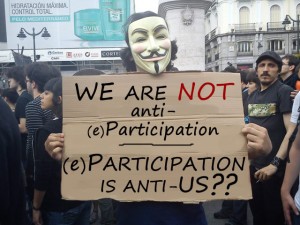 We see this paper as an urgent “call for self-reflection” and consider it a “MUST READ” for anyone involved in European eParticipation: from the officials working at EC’s Directorate for Information society and Media, to the researchers, practitioners, NGOs, public workers, citizen associations… and even any interested European citizen.
Therefore, we would like to encourage all our PeP-NET friends and in general all people with interest in eParticipation… to have a look at the paper during this nice summer weekend.
Anyone who feels “touched” by any of the paper’s claims and argumentations… should speak up and comment to this post. It doesn’t matter if it is to support, extend or complement our asseverations, or to oppose, challenge or further qualify them… please, share your views.
PeP-NET was meant to be a HUB for the conversations around eParticipation. So… let’s discuss. It is important that the issues we showed –be them real or imagined– are talked about, and possibly acted upon.
The environment where we operate is moving. Moving faster and faster. And in the context of the ‘Europe 2020 Strategy’ and its flagship initiative “Innovation Union”, which aims to renew EU’s “Research and Innovation Funding Programmes”, the most important question we need to answer is: “What do we do now??”
For sure, we could keep pretending that there is NO elephant in the living room. Stay in our “academic” Ivory Tower, and just continue doing as we did so far… while we wait for the “barbarians of eParticipation” to arrive, change the democratic landscape by really integrating ICT in governance… and make fools of all us. PeP-NET subscribers included.
But in our association we want to believe that we, the European eParticipation Community, could do much better than that.
So… no more to say!! Thank you very much for your attention. We hope some of you enjoy reading of our paper and some exchange of ideas can happen afterwards.
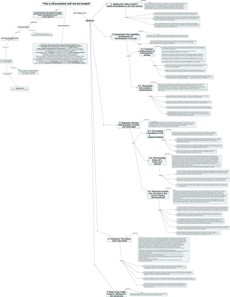
—– ADDITION: A CONCEPTUAL MAP SUMMARISING PAPER’S KEY FINDINGS —–
Several people asked for a “summary” version of the paper. Here you have a JPG image (2,5 Mbytes) displaying a Conceptual Map that summarises the paper’s key findings.
I recommend you to save the file first, and then open it with an image editor (like Office Picture Manager) to watch it. It’ll be more easy for you to zoom in and out in the different parts of the image.
Posted in ICT, Projects, Tools, Trends, Visions | 24 Comments »
|
|
9. June 2011 – 12:11 by Asociacion Ciudades Kyosei / Pedro Prieto-Martin
|
News from the Asociación and our main project (english version at the bottom 😉 ).
—
Como resultado del nuevo escenario creado en España por movimiento cívico “15M”, que ha inundado las plazas de las principales ciudades españolas (y algunas del extranjero) con sus demandas de una “Democracia Real YA”, en la Asociación Ciudades Kyosei hemos decidido “ponernos las pilas”, para producir cuanto antes una versión alpha del sistema “Kyopol” (aka. “Ciudad Simbiótica”), que podamos poner al servicio de todos los procesos de activación cívica y movilización social que deberían ahora darse, barrio a barrio, en todas las ciudades de España.
Ello nos ha demandado un un cambio de actitud: se hace necesario establecer un equipo más amplio, repartir responsabilidades… y así crear algo útil cuanto antes.
Pues bien, tras un par de reuniones muy productivas ayer martes y el pasado domingo… ¡¡el proceso de creación del Sistema Kyopol se considera “oficialmente iniciado”!!
El Sistema Kyopol (aka. “Ciudad Simbiótica”) fomentará la Implicación Cívica y la “Activación Ciudadana” en los ámbitos municipal y regional. Permitirá a los ciudadanos informarse, formarse y colaborar unos con otros en la mejora de su entorno vital, trabajando en aquellas temáticas que cada uno considere importantes.
No sólo eso: buscaremos que usando el Sistema Kyopol… ¡¡podamos pasarlo “de miedo”!! Que sea una experiencia tremendamente placentera, incluso divertida, eso de unirte a otras personas para implicarte en el “cuidado de lo publico”.
Para la Asociación Ciudades Kyosei… ¡¡haber logrado alcanzar este hito es algo sensacional!! Queremos agradeceros a todos los simpatizantes de la asociación el apoyo que nos habéis brindado hasta ahora y advertiros… ¡¡que ahora es cuando empieza el trabajo de verdad!!
Nuestro trabajo se desarrollará a partir de ahora mediante la estrecha colaboración de dos equipos:
- Primeramente, el “Grupo impulsor” -compuesto por informáticos, investigadores y personas vinculadas con la participación- construirá prototipos del sistema y establecerá las metodologías, los recursos participativos y los arreglos institucionales que formarán parte del sistema.
- En segundo lugar, el “Colectivo de pioneros”, integrado por representantes de todos los colectivos que usarán el sistema (desde ciudadanos y asociaciones de vecinos a políticos y técnicos municipales, pasando por medios de comunicación, ONGs, sindicatos y partidos políticos y, por supuesto, ahora también movimientos sociales del estilo 15M, DRY y demás bichos que éstos engendrarán en los próximos meses), que nos ayudarán probando los sucesivos prototipos del sistema, y proporcionandonos feedback en relación a las funcionalidades y procedimientos que propongamos.

En base a ello, podremos disponer de una versión Beta del sistema, lo suficientemente madura para iniciar proyectos piloto. Primeramente en el entorno de Madrid -que es de donde provienen la mayoría de nuestros Pioneros”-, y posteriormente en todas las regiones de España, y finalmente en el ámbito Latino-Americano y Europeo.
Si tenéis interés en formar parte del “Colectivo de Pioneros”, por favor contáctanos cuanto antes.
Planeamos realizar un acto de presentación del proyecto a todos sus potenciales interesados, en las instalaciones de la Universidad de Alcalá. ¡¡Os invitamos a tod@s a que nos acompañéis en el evento!!
Os mantendremos informados (podéis seguirnos en la web de la asociación, facebook o twitter).
—–
Urged, and inspired, by the emergence of the #SpanishRevolution, which has crowded the main squares of many spanish cities (and several foreign ones too!) to demand a “Real Democracy NOW!”… we have tried to accelerate our association’s projects.
And… after a couple of very productive meetings on Tuesday and on last Sunday … the construction of the “Kyopol System” has been “officially started”!
Kyopol (aka. “Symbiotic City”) will promote “citizen activation” and civic involvement in the municipal and regional levels. It will allow citizens to inform themselves about civic issues, “educate” themselves on how to “participate”, and collaborate with each other to improve their shared living environment, by collaboratively working on those issues that each one considers important.
Actually, our aim is that by using Kyopol we citizens will be able to experience a great deal of fun (and proudness!). Isn’t that the way that “meeting fellow citizens to jointly care and work for the common good” should taste?!
For the Asociación Ciudades Kyosei… having reached this milestone is something sensational! We want to thank all supporters of the association for the help we have received so far, but also warn them… that the real work is about to start!!
Our work will be developed through the collaboration of two teams:
- First, the “Core Team”, which is mainly composed of developers and citizen participation’s researchers, practitioners and stake-holders, who will work together to construct prototypes and establish the participatory methodologie,s the formative resources and the institutional arrangements that will surround Kyopol.
- Second, a “Pioneers Team”, that integrates representatives of all groups that will use the system (citizens, neighbourhood associations, governments oficials, politicians, NGOs, media, social movements, etc…). They will act as “Alpha testers”, and will help us testing our prototypes and providing feedback in relation to the functionalities and the participatory methodologies and resources we propose.
Based on this work, we will construct a Beta version of the system, mature enough to initiate pilot projects. These will first first in the surroundings of Madrid, where most of our Pioneers are located, and will afterwards get extended to several regions in Spain, and finally to the wide Latin American (and European) environments.
The next milestone we are planning is a meeting at the University of Alcalá, where the project will be presented to all potential stakeholders. Collaborative work will start immediately afterwards.
We’ll keep you informed (and you can follow us on our website, facebook or twitter).
Posted in ICT, members, Projects, Tools, Visions | No Comments »
 |
16. March 2011 – 10:06 by Bengt Feil (TuTech Innovation GmbH)
|
 We have seen countless examples of digital campaigns interlocking with offline activities aimed at protesting against something or the other. And even though I agree that protest campaigns can be very important we have seen far less examples of digital activism for a particular thing. I would like talk about one initiative that makes use of the net and our role as consumers to facilitate actual positive change in the offline world.
The Carrotmob initiative was started in San Francisco in 2008 and wants to make use of strategic consumption to change businesses behaviour. The video below shows how this approach works:
How Organized Consumer Purchasing Can Change Business from carrotmob on Vimeo.
The key aspect is that all participants, consumers and businesses, can achieve their goals without damaging the other. The buycott (as opposed to boycott), as it is sometimes called, does make use of core market principles and therefore is a “capitalist friendly” way of activism.
Even though the actual actions or buycotts are very local the initiative has spread to many countries all over the world. The internet is used both to communicate on the worldwide scale and to organise the local events. The organisers make use of their own websites and platforms like Facebook or Twitter to, in the end, organize offline activities.
Form this point of view the net is just a tool which helps to globalize and organize a creative form of activism. But I would argue that this kind of coordinated action and the quick spread to this many countries would not have been possible without the use of the net a tool for communication.
Thanks to Thore for introducing me to the idea.
Posted in Tools, Trends | 3 Comments »



evolutionWillNotBeFunded-Summary.jpg)