Only articles in with the "inenglish" tag are displayed
To display all articles click
here.
|
21. July 2011 – 17:45 by John Heaven (TuTech Innovation GmbH)
|

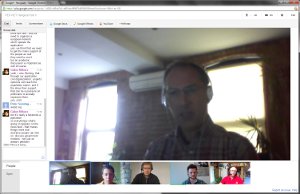
Me, posing in Second Life
This morning I went for a walk in a place on the other side of the channel which doesn’t exist yet. All without leaving my desk. Thanks to Birmingham’s Second Life model of the Library of Birmingham, the real life version of which is due to be opened in 2013, I was able to have a look at what they’re planning.
A couple of months back I blogged about Birmingham’s virtual model of the Library of Birmingham, then in the later stages of development. Earlier this month the Virtual Library went live, meaning that people from Birmingham (and beyond) can see a virtual model of the library that is scheduled to open in 2013 and let the developers know what they think.
As a Brummie, I recognised Centenary Square, and it was clear where the new library will be located and easy enough to get in (although Second Life can take a bit of getting used to before you start walking like you’re sober). Almost all areas of the library are accessible, and you can even choose whether to take the escalators or teleport to the different floors. It gives a good feel of how the library will eventually look and I noticed that some people had already commented on the building: one visitor was “concerned about the floor — it might do your head in!” and someone advised “Make sure the tables are able to be used by disabled people and children.”
As I mentioned in my previous article, the Virtual Library launch is being accompanied by a range of activities to ensure that it doesn’t go unnoticed in Second Life. Regular workshops are being held at the current library for the public, who are then able to use the computers at the library to access Second Life or go home and try it themselves. Those who don’t fancy signing up for Second Life can either view fly-through videos of the library or submit their comments using questionnaires.
For more information about the launch of the Virtual Library, you see the press releases from Birmingham City Council and from Daden, the company that created the model. I’m going to get an update from library staff after their current phase of outreach work, so watch this space!

Can you spot me?
Posted in good practice, News, Projects, Trends | 2 Comments »
|
5. July 2011 – 11:48 by John Heaven (TuTech Innovation GmbH)
|

Photo by xaibex on Flickr
Starting today (5th July 2011), citizens in the German city of Ulm are invited to take part in a discussion on the redevelopment of the central station. The online discussion platform, developed by DEMOS Gesellschaft für E-Partizipation mbH, will be online until 29th July.
The first building block of the Citybahnhof concept will be the development of a new concept for the central station itself, which will involve the participants in discussing which aspects they feel are important in terms of design and transport connections to the city centre. As well as the more detailed subject matter, there are more wide-ranging issues which citizens can discuss and make suggestions about; for example the organisation of the new central station, the public transport hub at the station, getting to and from the station as well as spatial planning aspects.
The basis of the disussion will be nine draft designs. The redevelopment of the central station is possible in the medium term and the rest of the area will follow in subsequent years and will be the subject of further consultation exercises.
How’s your German? You can take a look at the site at: www.ulm-citybahnhof.de
Posted in Events, members, News, Projects | No Comments »
|
9. June 2011 – 12:11 by Asociacion Ciudades Kyosei / Pedro Prieto-Martin
|
News from the Asociación and our main project (english version at the bottom
).
—
Como resultado del nuevo escenario creado en España por movimiento cívico “15M”, que ha inundado las plazas de las principales ciudades españolas (y algunas del extranjero) con sus demandas de una “Democracia Real YA”, en la Asociación Ciudades Kyosei hemos decidido “ponernos las pilas”, para producir cuanto antes una versión alpha del sistema “Kyopol” (aka. “Ciudad Simbiótica”), que podamos poner al servicio de todos los procesos de activación cívica y movilización social que deberían ahora darse, barrio a barrio, en todas las ciudades de España.
Ello nos ha demandado un un cambio de actitud: se hace necesario establecer un equipo más amplio, repartir responsabilidades… y así crear algo útil cuanto antes.
Pues bien, tras un par de reuniones muy productivas ayer martes y el pasado domingo… ¡¡el proceso de creación del Sistema Kyopol se considera “oficialmente iniciado”!!
El Sistema Kyopol (aka. “Ciudad Simbiótica”) fomentará la Implicación Cívica y la “Activación Ciudadana” en los ámbitos municipal y regional. Permitirá a los ciudadanos informarse, formarse y colaborar unos con otros en la mejora de su entorno vital, trabajando en aquellas temáticas que cada uno considere importantes.
No sólo eso: buscaremos que usando el Sistema Kyopol… ¡¡podamos pasarlo “de miedo”!! Que sea una experiencia tremendamente placentera, incluso divertida, eso de unirte a otras personas para implicarte en el “cuidado de lo publico”.
Para la Asociación Ciudades Kyosei… ¡¡haber logrado alcanzar este hito es algo sensacional!! Queremos agradeceros a todos los simpatizantes de la asociación el apoyo que nos habéis brindado hasta ahora y advertiros… ¡¡que ahora es cuando empieza el trabajo de verdad!!
Nuestro trabajo se desarrollará a partir de ahora mediante la estrecha colaboración de dos equipos:
- Primeramente, el “Grupo impulsor” -compuesto por informáticos, investigadores y personas vinculadas con la participación- construirá prototipos del sistema y establecerá las metodologías, los recursos participativos y los arreglos institucionales que formarán parte del sistema.
- En segundo lugar, el “Colectivo de pioneros”, integrado por representantes de todos los colectivos que usarán el sistema (desde ciudadanos y asociaciones de vecinos a políticos y técnicos municipales, pasando por medios de comunicación, ONGs, sindicatos y partidos políticos y, por supuesto, ahora también movimientos sociales del estilo 15M, DRY y demás bichos que éstos engendrarán en los próximos meses), que nos ayudarán probando los sucesivos prototipos del sistema, y proporcionandonos feedback en relación a las funcionalidades y procedimientos que propongamos.

En base a ello, podremos disponer de una versión Beta del sistema, lo suficientemente madura para iniciar proyectos piloto. Primeramente en el entorno de Madrid -que es de donde provienen la mayoría de nuestros Pioneros”-, y posteriormente en todas las regiones de España, y finalmente en el ámbito Latino-Americano y Europeo.
Si tenéis interés en formar parte del “Colectivo de Pioneros”, por favor contáctanos cuanto antes.
Planeamos realizar un acto de presentación del proyecto a todos sus potenciales interesados, en las instalaciones de la Universidad de Alcalá. ¡¡Os invitamos a tod@s a que nos acompañéis en el evento!!
Os mantendremos informados (podéis seguirnos en la web de la asociación, facebook o twitter).
—–
Urged, and inspired, by the emergence of the #SpanishRevolution, which has crowded the main squares of many spanish cities (and several foreign ones too!) to demand a “Real Democracy NOW!”… we have tried to accelerate our association’s projects.
And… after a couple of very productive meetings on Tuesday and on last Sunday … the construction of the “Kyopol System” has been “officially started”!
Kyopol (aka. “Symbiotic City”) will promote “citizen activation” and civic involvement in the municipal and regional levels. It will allow citizens to inform themselves about civic issues, “educate” themselves on how to “participate”, and collaborate with each other to improve their shared living environment, by collaboratively working on those issues that each one considers important.
Actually, our aim is that by using Kyopol we citizens will be able to experience a great deal of fun (and proudness!). Isn’t that the way that “meeting fellow citizens to jointly care and work for the common good” should taste?!
For the Asociación Ciudades Kyosei… having reached this milestone is something sensational! We want to thank all supporters of the association for the help we have received so far, but also warn them… that the real work is about to start!!
Our work will be developed through the collaboration of two teams:
- First, the “Core Team”, which is mainly composed of developers and citizen participation’s researchers, practitioners and stake-holders, who will work together to construct prototypes and establish the participatory methodologie,s the formative resources and the institutional arrangements that will surround Kyopol.
- Second, a “Pioneers Team”, that integrates representatives of all groups that will use the system (citizens, neighbourhood associations, governments oficials, politicians, NGOs, media, social movements, etc…). They will act as “Alpha testers”, and will help us testing our prototypes and providing feedback in relation to the functionalities and the participatory methodologies and resources we propose.

Based on this work, we will construct a Beta version of the system, mature enough to initiate pilot projects. These will first first in the surroundings of Madrid, where most of our Pioneers are located, and will afterwards get extended to several regions in Spain, and finally to the wide Latin American (and European) environments.
The next milestone we are planning is a meeting at the University of Alcalá, where the project will be presented to all potential stakeholders. Collaborative work will start immediately afterwards.
We’ll keep you informed (and you can follow us on our website, facebook or twitter).
Posted in ICT, members, Projects, Tools, Visions | No Comments »
|
7. June 2011 – 11:44 by John Heaven (TuTech Innovation GmbH)
|

Photo by Wrote on Flickr
Like their counterparts worldwide, local authorities in Germany are working out how to surf the web in something that is more like a huge ship than a surfboard, and how to provide something that surfers want instead of intruding on what they are doing and making them flee for the safety of the beach. As one PEP-NET Member, the City of Hamburg, publishes its social media guidelines, I review social media in German public administration.
The current issue of Kommune 21, a German E-Government magazine, gives a good overview of the social media landscape in Germany. There is a piece on Stuttgart’s comprehensive strategy for integrating several social media tools to ensure that their message gets to its target audience whilst remaining open to feedback; the City of Moers is also trying out several social media tools and has developed social media guidelines; and the City of Braunschweig reports how it has helped create a community of equals, Facebook users who exchange insider tips on which restaurants and cafés to go to.
However, Germany is well known for its suspicion of anyone who attempts to collect their data, whether the state’s pre-emptive collection of telephone records or Google’s photographing people’s houses for Street View. (Try taking a tour of a German residential area on Google Street View and you will see that many people have had their houses blurred out.) This issue will not go away, what with the increasing importance of cloud computing and the wealth of online applications that we use day to day. So Datenschutz, or data protection, is high on the agenda and warrants a place in all social media guidelines, including Hamburg’s.
Hamburg’s recently published guidelines explain some of the most common tools, describing social media use by German local authorities and providing examples of scenarios in which social media could be used. The case studies come from across Germany and indeed from across the world: from San Francisco’s activities on Twitter to the Stadtwiki Karlsruhe via Maerker Brandenburg, the Fix My Street-like service that allows citizens to report problems to their local authority and view status updates online.
On top of that, the suggested scenarios illustrate what can be achieved with social media, and how to go about it. These fictional scenarios are: a directorate uses Facebook, a district office publicises times for vaccinations on Twitter, the Culture Directorate posts videos of cultural events on YouTube, the HR department uses XING to acquire new staff, a senior official blogs, and a directorate conducts a survey with SurveyMonkey.
Each of these scenarios is accompanied by a flowchart which really nails down the procedure that has to be gone through when setting up something as simple as a WordPress blog: the departments that have to be consulted, the problems that have to be anticipated, the extra work involved and issues that have to be considered. I found this part especially interesting because, although it may seem onerous to go through such a long procedure for setting up a Twitter account, I think it is right to be honest with the public and employees about the reality of social media within a large public sector organisation like Hamburg.
So there is a lot going on in Germany in the field of open government, which thanks to projects such as Apps 4 Berlin and Munich Open Government Day, which open data to the public and encourage enthusiasts to develop apps that make use of them, is not limited to social media use. Maybe more on that in a later blog post …
Posted in good practice, members, News, Projects, Trends | 1 Comment »
|
14. March 2011 – 14:46 by John Heaven (TuTech Innovation GmbH)
|

Voting via the internet
The Estonian national elections took place on 6th March, returning the incumbent centre-right coalition to power. As in previous elections, citizens were also able to cast their vote over the internet — this time from 24th February to 2nd March.
The overall election turnout increased only marginally (by less than two percentage points over the last general election) but there was a massive rise in voters who cast their vote on the internet, from 5.5% to 24.3%. This may be partly due to the longer time during which voters could go to the online polls, which increased from three days to seven; but it also suggests an increasing awareness and acceptance of the technology.
As well as voting online, Estonians made use of other online tools to help them decide whom to vote for: the website http://valijakompass.err.ee/, which is a tool that helps voters pick a party according to the policies they agree with, reports over 100,000 hits. (Thanks to Hille Hinsberg for the tip-off!)
You can find a more detailed analysis of the results by Manuel Kripp, Director of the Austrian E-Voting Competence Centre E-Voting.cc, here.
Posted in News | No Comments »
|
11. March 2011 – 10:05 by John Heaven (TuTech Innovation GmbH)
|

"IE6 Death Cake" by amberlrhea on Flickr
A campaign to put Microsoft’s decade-old web browser, Internet Explorer 6, out of its misery is nothing new. There has even been a petition on the UK Number 10 petitions website calling on government to upgrade to a modern browser, which was rejected, and Google dropped IE6 support for its apps more than a year ago.
The novel thing about ie6countdown.com is that the organisation behind it is, er, Microsoft. Needless to say, they call upon users to upgrade to Internet Explorer 8 and don’t mention the other browsers out there (such as Firefox, Chrome, Safari and Opera). Anticipating probably the main argument for retaining IE6, they dedicate a part of the website to corporate users.
Developers have long complained that adding support for IE6 adds complication and cost to the process of creating websites that government employees can use. From a government employee’s perspective, IE6 is just another barrier to engaging with the outside world through the internet on top of restrictions on social media access and third-party software such as Skype. 3.5% of UK users are still hooked on IE6, as are 2.9% of German users, and 3.3% of Italian surfers. Finland and Norway lead the way with 0.9% and 0.7% respectively.
So, will this add to the pressure on governmental organisations to make the switch?
Posted in Uncategorized | No Comments »
|
3. March 2011 – 11:02 by John Heaven (TuTech Innovation GmbH)
|

Photo by Techie Kev on Flickr.com
As reported in the Guardian, Walsall City Council is conducting a 24 hour experiment to publicise what it does. Starting at 6.00 UK time today, four Twitter streams will be pumping out updates from nuisance neighbour reports to pest control.
The Twitter accounts @walsall24_1 to @walsall24_6 have been reserved, although at the time of writing only two seem to be tweeting — presumably the rest have been reserved to prevent spoofers setting up bogus accounts (which, to my juvenile mind, seems a bit of a shame).
The experiment follows a similar campaign by Manchester Police, who tweeted over a 24 hour period recently.
For more information, see the Walsall City Council website: http://www.walsall.gov.uk/walsall24.htm.
PS: There’s a free candy floss and a goldfish if you understood the pun in the title.
Posted in Uncategorized | No Comments »
|
19. January 2011 – 11:44 by John Heaven (TuTech Innovation GmbH)
|
A report to the European Commission recently called upon Member States to step up their efforts to digitise catalogues of cultural works including books and paintings. This presents some challenges which I think help us to reflect on issues surrounding open data.
The act of digitising works costs money and doing it properly – ensuring that prints are of a high quality and high enough resolution to make them useful – can be expensive. As with any expenditure, public organisations have to demonstrate that their investment is justified by a public need or that they can recoup the money by selling what they produce. This is exactly what Birmingham Museum and Art Gallery has done by selling on-demand prints of their works online. The argument that these works are public property and should be available free of charge may hold in principle, but if all works are made freely available then the funding must come from elsewhere or they simply won’t be digitised in the first place.
I think the same applies to open data: the data may be on paper, or uncollected. The act of collating this data simply for the purpose of making it public costs money and this investment will need to be justified against many other competing demands on the public purse. Where data is already in digital form and it is simply a case of putting a spreadsheet on the internet, the argument is more straightforward; but when it costs money to collect it and make it available it is more complicated, especially if the data is already a source of income. Why would you want to give companies that happily pay handsome sums for, say, mapping data this information free of charge? Why spend lots of money collating data that perhaps nobody will use?
The Localism Bill (see previous article) attempts to solve this by releasing data according to the wishes of local residents. I think we should be exploring other ways of ensuring that data remains a source of income whilst being available for people like community activists and volunteers who want to use data to improve their surroundings.
Public authorities should think about making data available under a Creative Commons licence. This could allow them to preserve their income streams by prohibiting commercial use, whilst allowing people to use the data for personal and voluntary means. It may even encourage more people to buy their datasets by giving them the option to “try before they buy”. Further, there may be some instances where a private company can work with a public authority to collect data for its own purposes and at its own expense. By obliging the company that collects the information to make it available for non-profit public use, this may be a way of covering the costs of data collection whilst retaining the principle of openness.
Posted in open data, Trends | 2 Comments »
|
17. December 2010 – 17:25 by John Heaven (TuTech Innovation GmbH)
|
You’ve joined us for live chats on the blog, taken part in our online discourses, chatted to us at conferences, read PEP-NET members’ articles, and downloaded the free PEP-NET Issue of JEDEM. Eighty-six of you even came to Hamburg to join us for the PEP-NET Summit. Before the year is out, we would like to ask you take part in one final activity: our survey “Looking Forward, Looking Back: eParticipation Trends in 2010 and 2011.”
So what were the main trends in 2010? What areas of eParticipation made particular progress, and what events defined the eParticipation calendar? And while you are thinking about trends, what do you think will be up and coming in 2011? Nobody can predict the future, but it will be interesting to find out how 2010 was for friends of PEP-NET, and what they expect in 2011.
When I’m back in the New Year, I’ll put together a summary of results. I think it will make for interesting reading – but only if you take part, that is!
In the meantime, from Edinburgh to Athens, Madrid to Minsk: wherever you are, Merry Christmas and a Happy New Year!
Posted in members, Trends, Visions | No Comments »
|
15. December 2010 – 10:25 by John Heaven (TuTech Innovation GmbH)
|
Far from winding down for Christmas, this week sees a lot of European eParticipation-related activity in Brussels and Strasbourg. The launch of the eGovernment Action Plan, the presentation of the Citadel Statement and the expected adoption of regulations on the European Citizens’ Initiative by the European Parliament in Strasbourg mean that this is a busy week for European eParticipation enthusiasts.
At the “Lift Off Towards Open Government” in Brussels, Digital Agenda Commissioner and Vice President of the European Commission Neelie Kroes will launch the eGovernment Action Plan 2015. Following the launch, the conference will hear from eParticipation and eGovernment actors from the Commission and across Europe.
At the pre-conference yesterday, Geert Bourgeois (Vice Minister-President of the Flemish Government and Flemish Minister for Administrative Affairs, Local and Provincial Government) launched the Citadel Statement, a pan-European declaration that aims to identify what local government really needs to deliver on the vision set forth in last year’s Malmo Ministerial Declaration on e-government. The Citadel Statement, the result of an open discussion in which anyone could makes suggestions and vote on other people’s suggestions, is broken down into the following headings:
- Common Architecture, Shared Services and Standards
- Open Data, Transparency and Personal Rights
- Citizen Participation and Involvement
- Privacy and Identification of Individuals
- Rural inclusion
Click here for a PDF version of the full press release.
Finally, the European Parliament will vote on regulations that specify in more detail arrangements regarding the European Citizens’ Initiative. The Lisbon Treaty made provision for one million citizens to force the Commission to consider initiating legislation in any area within its remit. A recent petition online called on the Parliament to adopt “effective regulations for the European Citizens’ Initiative”; see my previous post.
Geert Bourgeois, Vice-Minister-President of the Flemish Government and Flemish Minister for Administrative Affairs, Local and Provincial Government
Posted in Events, News, Trends | No Comments »