Archive for the ‘News’ Category
 |
12. January 2015 – 01:33 by Gov2U
|
Call for Authors: Beyond e-Government Measuring Performance: A Global Perspective
The Public Technology Institute (PTI) based in Washington, DC. and ITEMs International, based in Paris, will publish a new book in its highly successful “Global Perspective” Series, Beyond e-Government Measuring Performance: A Global Perspective to be published late 2009. This new book will explore the scope, growth, technology, applications, reporting systems regarding measuring e-Government. The principle authors/editors will be Dr. Alan R. Shark (
www.pti.org) and Dr. Sylviane Toporkoff. (
https://www.items.fr/).
Experts in the field in performance measurement of local government e-Government initiatives that are interested to be considered as an author are invited to contact either Dr. Shark (email:
shark@pti.org ) or Dr. Toporkoff ( e-mail:
stoporkoff@items-int.eu).
Expression of interest (one page outline of the proposal as well as a short bio) must be received by March 30th 2009.
Posted in News | No Comments »
 |
8. October 2012 – 17:33 by John Heaven (TuTech Innovation GmbH)
|
It was all about transparency this weekend in Germany, and here’s why.
German’s largest opposition party, the SPD, has finally decided who their candidate for Chancellor will be at the next elections – and already he is getting into problems due to paid speaking engagements during his time as a Member of Parliament.
Peer Steinbrück stands accused of neglecting his job as an MP and of potential bias in favour of banks that paid him for speaking engagements. He has responded by denying the allegations and promising to publish details of how much he received from whom, and what topic he spoke on, and calling for more transparency around German MPs’ earnings gained from second jobs. Having said that, he asserts that “transparency only exists in dictatorships.”
Abgeordnetenwatch, a German website similar to TheyWorkForYou.com operated from Hamburg, has weighed in on the argument. Their founder, Gregor Hackmack, called Steinbrück “a black sheep” amongst MPs: “There is a small number of MPs – Peer Steinbrück, Michael Glos or Heinz Riesenhuber – who have earned a particularly high amount alongside their work as an MP and are neglecting their duties,” presumably calling upon figures gathered through Abgeordnetenwatch. This episode could be a boost for the transparency agenda in a similar way to the MPs expense affair in Britain.
Abgeordnetenwatch was also in the headlines over the weekend because the Hamburg Transparency Law entered into force. Along with other campaigners (Mehr Demokratie e.V., Chaos Computer Club, Transparency International) who successfully forced it through, Abgeordnetenwatch celebrated the entering into force of the Hamburg Transparency Law on Saturday. As I wrote previously, the law was suddenly and surprisingly adopted back in June and requires a greater level of transparency by default, including the creation of an information register.
At the event on Saturday, held at Kultwerk West, the portal “Frag Den Staat” was made available to users in Hamburg to coincide with the transparency law. Similar to the UK’s “what do they know”, the website allows citizens to make freedom of information requests in public and post the responses to the website. Ideas for information requests were collected from the audience and some requests were made in order to demonstrate to the audience how the website works.
In the name of transparency, I suppose I should mention that I’m an unpaid team member at Kultwerk West, where the event was hosted.
Posted in News, open data | No Comments »
|
|
17. September 2012 – 13:49 by John Heaven (TuTech Innovation GmbH)
|
Every year, Bearing Point and Cisco Germany award a project the title of “the most innovative e-government project in the German-speaking world”. This year, the Federal State of Schleswig-Holstein was nominated for their project BOB-SH* in which they implemented DEMOS-Plan, our software for managing spatial planning consultations online. And they won!
So we’ve been feeling a little bit innovative for the past week too. After all, we worked closely with Schleswig-Holstein, giving technical support, training and telephone assistance to the wide range of stakeholders who will be working with DEMOS-Plan.
DEMOS-Plan is an online tool that closely follows the procedure laid down by German law for conducting consultations on a particular type of spatial plan (the “Bebauungsplan”). It allows statutory stakeholders to manage submissions internally by requiring one representative to sign off the submissions from different departments. These submissions can be linked to a particular paragraph of the planning document and/or the participant can draw on a map of the plan.
It’s great for the planning authority, because it saves them the trouble of sending paper copies of plans and collating all the submissions manually: instead, this is done automatically.
We think there are other countries in Europe where DEMOS-Plan could be useful and have been investigating this through the Parterre project. If you were at the PEP-NET Summit, you may have caught Francesco Molinari’s presentation of Parterre. (Hopefully you will also have noticed that the Summit was sponsored by Parterre!)
There will be more news on Parterre soon, so keep your eyes on the blog!
* Bauleitplanung Online-Beteiligung Schleswig Holstein
Posted in good practice, ICT, members, News, Tools, TuTech | No Comments »
|
|
19. June 2012 – 11:06 by John Heaven (TuTech Innovation GmbH)
|
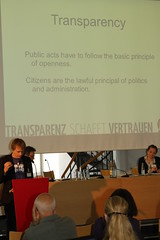
Daniel Lentfer presents the Transparency Law at the PEP-NET Summit 2012
Campaigners for a local transparency law, the so-called Transparenzgesetz, can look forward to a summer watching the football with a cool bottle of Astra and a Bratwurst. Expecting stiff resistance from the local authority, they had planned to spend the next few months preparing for the next round of a local citizen’s initiative, which would have required them to collect thousands of signatures in order to force a referendum. But to many people’s surprise, an adapted version of the law was passed last week.
Following negotiations with all parliamentary party groups and the campaign’s initiatiors (Mehr Demokratie, Transparency International and Chaos Computer Club), a text was agreed upon and passed on 12th June. By introducing an inventory of publicly held information, including data, and obliging public servants to open information by default, the law will go a long way to increasing transparency in the local authority. The types of information that are included in the duty to publish are, amongst others, contracts for public services, official statistics, geodata and spatial development plans. Where there are compelling reasons, such as data protection or the protection of sensitive business information, the duty does not apply.
This law supersedes the Freedom of Information Law, passed in 2009. Hamburg’s wide range of instruments for involving citizens extend from citizens’ initiatives on a local level to livestreaming parliamentary proceedings, via the online spatial planning consultation system that TuTech developed with the city. The Transparency Campaign and the Parliament are in agreement that Hamburg is set to become Germany’s most transparent state, its transparency capital. As far as I know, this is the best example of open data and transparency being pushed through by a civil society campaign.
Posted in News, open data, Trends | No Comments »
|
|
16. May 2012 – 19:15 by John Heaven (TuTech Innovation GmbH)
|
 The past week has seen a feast of eParticipation in Hamburg: the Open Government Stammtisch at Kultwerk West last Wednesday evening, a pre-Summit warm up with Nick Booth at Kultwerk West on Sunday evening, the Summit itself, and the first Hamburg social media surgery on Monday evening. It’s been energising, inspiring, refreshing and exhausting all at once.
Hamburg has a growing network of eParticipation experts/enthusiasts, a community that has been given new life by Government 2.0 Netzwerk‘s efforts to revitalise it by organising regular information meetings (Stammtische), one of which was held here at TuTech. So the idea behind the Summit was to feed this community with new ideas from outside Germany, but also to show the outside world what Hamburg has to offer.
In terms of learning from new ideas, we heard from Nick Booth about social media surgeries and his theory of Zero Expectations; Peter Verhaeghe’s ideas about the role of an architect as a mediator between citizens and politics; Erik Tissingh’s presentation of 3D citizen participation tools. Then there were the informal presentations in the break with presenters from Germany, the UK, Austria, Italy and Denmark.
And on the second point: Hamburg’s campaign for a local transparency law is unlike anything elsewhere in Europe. As far as I can see, it is the only high-profile open data campaign of its type. And with Twitter comments like this — “Everyone doing participation should have @nexthamburg‘s principles above their desk” — no-one can deny that Hamburg has a lot to say about participation.
Judging by the feedback, we managed to do what we set out to. To organise such an event wouldn’t have been possible without PEP-NET: the contacts, the brand, the publicity tools such as the mailing list and the blog. We got in touch with Peter Verhaeghe thanks to a suggestion from Dieter van de Putte, of PEP-NET member De Wakkere Burger. So with a bit of creativity and quite a bit of work, we made the most of PEP-NET and everyone’s a winner. We had a blast!
For more information about what was discussed, have a look at the full report by Noella Edelmann from the Centre of E-Governance at the Danube University.
Posted in Events, News | No Comments »
 |
30. March 2012 – 14:01 by Rolf Luehrs
|
 Prof. Patrizia Nanz is Professor of Political Theory at the University of Bremen and a founding member of the European Institute of Public Particiaption (EIPP). She will be delivering the keynote address at the upcoming “PEP-NET Summit: Out in the Open” event on 14th May 2012.
Patrizia has been conducting research into the future of democracy for over ten years and is known across Europe as an expert in civil society participation and engagement. In March 2012 the Bundeszentrale für politische Bildung (Federal Centre of Political Education) published her handbook on participation, Handbuch Bürgerbeteiligung. Verfahren und Akteure, Chancen und Grenzen.
Patrizia studied Philosophy, History and German Language and Linguistic Studies in Munich, Frankfurt and Montreal as well as Political Science at the European University Institute in Florence, and was a Fellow at the Institute for Advanced Study in Berlin.
Posted in Events, News | No Comments »
|
|
29. March 2012 – 13:11 by John Heaven (TuTech Innovation GmbH)
|
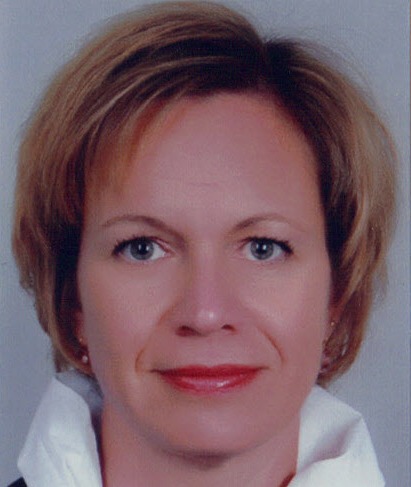
Alenka Krek-Poplin
Having studied Surveying in Ljubljana before specialising in Geographical Information Systems through work and academic study in Austria, the US and Germany, Prof. Alenka Krek-Poplin is co-founder of Hamburg’s Digital City research group, which focuses on the application of spatial data-modelling to city planning. She writes, researches and teaches on computer-aided participation in spatial planning at the HafenCity University Hamburg.
Alenka’s work focuses on how, by adding an element of fun and enjoyment (or joy) to spatial planning, it can be made more interactive and compelling and thus increase levels of participation. Her recent article “Playful public participation in urban planning: A case study for online serious games” explores aspects such as story-telling, sketching and drawing, and digital games that have the potential to make public participation (in my words) easier and less boring.
The example she draws upon in the article, Nextcampus, was a prototype of a game that she and some of her students designed and simulated. The prototype game dealt with the suggested relocation of the University of Hamburg, which has been a hot topic in recent years.
Added to this, she has conducted several projects that explore the use of public participation through geographical information systems. One of these projects was a survey of how people use the waterways around Wilhelmsburg, an island in Hamburg’s River Elbe. Participants were asked whether they carry out certain activities and were able to draw on the map, stating where they engage in them.
The most recent example, sowillichleben.com, is a website built by students to enable them to influence the building of their halls of residence in a game-like manner. One of the ways students were able to express their wishes was to stick virtual notes on areas that represented private room, communal area, and surrounding area. So they could, for example, stick a note with “privacy” on the part representing their room, and “meet new people” on the part representing the communal areas. She has also been involved in a project that enabled citizens to plan the layout of a town square using 3D objects.
In her paper describing Nextcampus, Alenka details some of the criticism that the model attracted from some experts who were asked to evaluate it. One of these was the difficulty in distinguishing between when participants are just playing, and when they are serious about what they are suggesting. I am looking forward to discussing this point at the PEP-NET Summit because it acknowledges a part of participation that I feel we pay much too little attention to. We tend to ignore that citizens always have participated in discussions with no expectation, or even desire, of their discussions leading to some kind of result, for example talking about politics at the pub, going to events to hear about political topics but not doing anything about them, and taking part in flashmobs; but this type of not-for-real participation is essential and, I suspect, one way or another leads to a much healthier public discourse and ultimately better public decisions.
Of course the other half of the equation is what to do with the results that people mean seriously, and we will be talking about that too!
For more information about the PEP-NET Summit and to register, visit https://amiando.com/pep-net. You can also find information at https://pep-net.eu/the-pep-net-summit-out-in-the-open/
Posted in News, Trends | No Comments »
 |
21. March 2012 – 12:46 by cynthiawagner
|
 The growth of movements like the Right to the City Movement and protests like Stuttgart21, Gängeviertel, or NO BNQ show the continuously increasing demand for more public participation in urban development. The pilot project Nexthamburg experiments with new ways of public participation in the urban development of Hamburg. The concept of the open and independent crowd-sourcing project will be presented at the PEP-NET Summit on 14th May.
Nexthamburg gathers solutions and challenges for the city of Hamburg in crowd-
sourcing processes. Citizens can post their own solutions for the big challenges on the webpage or other Nexthamburg social media channels, discuss, comment or follow others, create their own vision for Hamburg. They can also participate in one of the Nexthamburg events, for example Nexthamburg Sessions, Salon, Zukunftscafés, or the Zukunftscamp.
The long-term goal of the project is to organize a crowd-funding channel for promising ideas for Hamburg’s urban development to finance feasibility studies and realization efforts.
Nexthamburg is active since April 2009 and has been promoted as a pilot project of national politics of urban development by the federal ministry for traffic, building, and urban development until 2011. It is supposed to become a non-profit association in 2012.
Nexthamburg on nexthamburg.de, facebook, twitter, google, flickr, youtube, issuu
Posted in Events, News, Projects, Visions | No Comments »
|
|
5. March 2012 – 17:28 by John Heaven (TuTech Innovation GmbH)
|

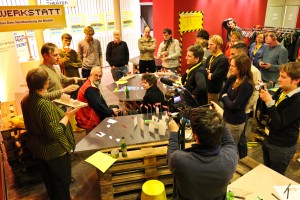
Photo of Kultwerk West
The social media surgery format, which was introduced by Nick Booth and others in 2008, has already spread beyond Birmingham to other parts of the UK and indeed abroad. Nick and his social enterprise Podnosh even won an award from the UK Prime Minister for their work. Now social media surgeries are coming to Germany and I’m really pleased to announce that Hamburg will be hosting the first one!
On 14th May 2012, the evening of the PEP-NET Summit, Kultwerk West (a voluntary organisation that I’ve been getting involved with in my spare time and whose website I rebuilt) will be organising an informal meeting between politically engaged citizens and people who know a thing or two about social media.
I think Kultwerk West is the perfect place to start, because the events we organise twice per week attract plenty of people who are interested in current affairs and are in many cases active citizens, but who are not necessarily comfortable using social media. In many cases, they are sceptical of them due to fear-factors like Datenschutz, data protection.
To make the occasion even more special, Nick Booth, who is in town to speak at the PEP-NET Summit, will be Hamburg’s first social media surgeon.
You can find out more about the social media surgery model at socialmediasurgery.com. If you are coming to the PEP-NET Summit and are interested in helping out at the first social media surgery in the evening, please get in touch via summit@pep-net.eu or leave a comment on this thread.
UPDATE: The Kultwerk West Social Media Surgery is now registered on socialmediasurgery.com, Podnosh’s online tool for managing social media surgeries.
Posted in Events, inclusion, News, Projects | 1 Comment »
|
|
23. February 2012 – 15:54 by John Heaven (TuTech Innovation GmbH)
|
Mehr Demokratie e.V., Transparency International and the Chaos Computer Club are campaigning for the adoption of a local law that would give Hamburg citizens and charitable organisations enhanced access to previously confidential information. Daniel Lentfer from Mehr Demokratie, a not-for-profit organisation that campaigns for more direct democracy in German politics, will present the Transparenzgesetz at the PEP-NET Summit on 14th May.
The proposed transparency law was drafted using a wiki, which was open for anyone who wanted to to participate. It calls for a central information register, listing all of the city’s official publications; a duty to publish, which includes public data; and the extension of the right to information to voluntary organisations, especially campaigning organisations and not merely private individuals.
The campaign argues that such a law would reduce corruption, reduce wasting of taxpayers’ money, increase trust in politicians and the local authority, simplify administrative procedures and make participation easier.
Mehr Demokratie e.V. successfully collected the 10,000 valid signatures required for a local Citizens’ Initiative and the state parliament’s judicial affairs committee will decide whether to accept the law on 28th February. Mehr Demokratie is preparing for it to be rejected, in which case they will have to collect a total of 62,000 valid signatures within three weeks to force a local referendum.
Posted in Events, News, open data, Trends | No Comments »