Only articles in with the "UK" tag are displayed
To display all articles click
here.
 |
25. May 2012 – 13:38 by John Heaven (TuTech Innovation GmbH)
|

Image: Wikimedia Commons, Mrjohncummings
The Welsh town of Monmouth is to become the world’s first “wikipedia town”. In a project that involves kitting out the whole town with free wifi hotspots and sticking QR codes on all significant monuments and places of interest, “Monmouthpedia” enables tourists to call up community-generated articles on their smartphones.
The project doesn’t simply use QR codes that link to a specific article, but to a wikipedia article in the user’s own language where available. This is enabled by the QR-Pedia website, which anyone can use to convert a link from a Wikipedia article into a QR code that ascertains the user’s language an delivers the article in the right language.
I can see this being a success because the QR codes make it much easier to find information about specific objects without having to type in a long, complicated URL, and you have a good idea of what information you are requesting. In many cases, QR codes are used unnecessarily (presumably because they are fashionable) on flyers and posters and link to a company’s website, which would be easier to call up by typing in the URL or searching for it. I also find that you often do not know what the QR code links to, which isn’t a great motivating factor either.
Another innovative example of QR code use is the Korean supermarket in an underground station that consists of pictures of products, each with an associated QR code. Again, the QR code links to a very specific object and it’s obvious what you can expect when you scan the code.
Posted in good practice | 2 Comments »
|
|
6. October 2011 – 18:31 by John Heaven (TuTech Innovation GmbH)
|
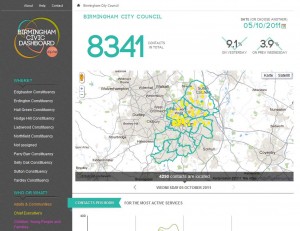
Birmingham Civic Dashboard screenshot
In its recent consultation document ‘Making Open Data Real’, the UK Government expresses high hopes for open data, heralding it as possibly “the most powerful lever of 21st century public policy”. Following several years of open data advocacy, activism and hack days, in the UK open data is moving towards the mainstream thanks to unanimous backing from the coalition government and the opposition.
The latest move in open data comes from Birmingham City Council, which today launched its ‘Civic Dashboard’. This is a web site publishing raw customer services data along with a slick visualisation, which was made possible by a grant that Digital Birmingham received as a result of winning a competition run by the National Endowment for Science, Technology and the Arts (NESTA).
The Civic Dashboard draws its data from the customer service centre set up as part of the Council’s Business Transformation programme. An extract of data about all customer enquiries, whether by telephone, internet or email, is recorded by the customer relationship management system and fed into the Civic Dashboard in an aggregated (anonymised) form once per day. Where the data is geocoded, it can be presented on a map to show how many contacts originate from a particular ward or constituency. You can even see which channels the enquiries come through, which shows that the Council receives far more enquiries by telephone than through other channels.
This is an important step towards bridging the gap between eGovernment and ‘weGovernment’. Coming from the Council that was heavily criticised for spending £2.8m on its website as part of its eGovernment transformation, especially by Birmingham’s vocal social media users, opening up the data that is produced in the background shows what the new infrastructure can do beyond serving up static content. Doubtless there are many more datasets that exist as a result of the transformation programme, and if these are released in the future, perhaps Brummies will feel they got a better deal out of transformation than they first thought.
This itself is quite a paradox: such a handover of control to the citizen wouldn’t have happened if it weren’t for the huge transformation programme because IT is absolutely necessary for the collection of data in a reusable form.
Read the rest of this entry »
Posted in good practice, News, open data, Trends | 1 Comment »
|
|
9. August 2011 – 11:26 by John Heaven (TuTech Innovation GmbH)
|
Claims that social networking tools were used to co-ordinate the London riots, which have since spread to other cities including my former home town, Birmingham, point to a new digital divide: this divide is not about online and offline, but about a divide between the Twitterati, Facebook users and users of other platforms.
Following broad-brush claims that social networks have been used to co-ordinate the rioting and plundering, Twitter users have been quick to respond, pointing to Twitter campaigns to clean up the streets following the riots. They are right, but that isn’t the end of the matter.
It turns out that the riots were co-ordinated using Blackberry smart phones, which allow anonymous, encrypted, but social, communication. Blackberries? I tend to associate Blackberries with conservative business users but I was surprised to read a BBC article last week reporting that teenagers who own smart phones prefer them. While it may seem logical that they choose Blackberry devices because of the privacy and anonymity they offer, the article suggests that privacy is more of concern to older users.
Previous concerns about the digital divide seem a little simplistic now. Previously we thought in terms of a divide between online and offline, seeing the ultimate goal as getting the “final third” online. Doubters were confronted with research that deprived youngsters, especially from ethnic minorities, were more often online than one might expect. The logical conclusion was that public services need to engage more with the online generation, usually in the form of YouTube, Twitter and Facebook. Now we find that there is a whole generation we risk ignoring because of assumptions about which social media tools they use.
When I worked for Birmingham City Council, I spent some time on a project to help heal the wounds of the riots in Lozells and Handsworth in 2005. Then, the lessons learned were that false information spread by pirate radio stations inflamed the situation, reinforcing tensions between ethnic and religious groups. Encouragingly, yesterday there was a report of Sikhs and Muslims from the area standing together to fend off the looters.
Just as things are moving on there, communication habits have moved on too. Back then, pirate radio was a blind spot and monitoring established radio stations simply couldn’t give any tip-offs about the violence. Now, the blind spot is Blackberry devices and presumably a whole host of other communication channels.
So do local authorities need to start opening channels with young Blackberry users, as a Guardian journalist has done? I think in some cases they will have to, but will also have a difficult job in keeping a keen eye on the latest trends in communication.
It looks like digital just divided again.
https://www.guardian.co.uk/uk/blog/2011/aug/08/london-riots-blackberry-messenger
Posted in Uncategorized | 7 Comments »
|
|
21. July 2011 – 17:45 by John Heaven (TuTech Innovation GmbH)
|

Me, posing in Second Life
This morning I went for a walk in a place on the other side of the channel which doesn’t exist yet. All without leaving my desk. Thanks to Birmingham’s Second Life model of the Library of Birmingham, the real life version of which is due to be opened in 2013, I was able to have a look at what they’re planning.
A couple of months back I blogged about Birmingham’s virtual model of the Library of Birmingham, then in the later stages of development. Earlier this month the Virtual Library went live, meaning that people from Birmingham (and beyond) can see a virtual model of the library that is scheduled to open in 2013 and let the developers know what they think.
As a Brummie, I recognised Centenary Square, and it was clear where the new library will be located and easy enough to get in (although Second Life can take a bit of getting used to before you start walking like you’re sober). Almost all areas of the library are accessible, and you can even choose whether to take the escalators or teleport to the different floors. It gives a good feel of how the library will eventually look and I noticed that some people had already commented on the building: one visitor was “concerned about the floor — it might do your head in!” and someone advised “Make sure the tables are able to be used by disabled people and children.”
As I mentioned in my previous article, the Virtual Library launch is being accompanied by a range of activities to ensure that it doesn’t go unnoticed in Second Life. Regular workshops are being held at the current library for the public, who are then able to use the computers at the library to access Second Life or go home and try it themselves. Those who don’t fancy signing up for Second Life can either view fly-through videos of the library or submit their comments using questionnaires.
For more information about the launch of the Virtual Library, you see the press releases from Birmingham City Council and from Daden, the company that created the model. I’m going to get an update from library staff after their current phase of outreach work, so watch this space!

Can you spot me?
Posted in good practice, News, Projects, Trends | 2 Comments »
|
|
3. March 2011 – 11:02 by John Heaven (TuTech Innovation GmbH)
|

Photo by Techie Kev on Flickr.com
As reported in the Guardian, Walsall City Council is conducting a 24 hour experiment to publicise what it does. Starting at 6.00 UK time today, four Twitter streams will be pumping out updates from nuisance neighbour reports to pest control.
The Twitter accounts @walsall24_1 to @walsall24_6 have been reserved, although at the time of writing only two seem to be tweeting — presumably the rest have been reserved to prevent spoofers setting up bogus accounts (which, to my juvenile mind, seems a bit of a shame).
The experiment follows a similar campaign by Manchester Police, who tweeted over a 24 hour period recently.
For more information, see the Walsall City Council website: https://www.walsall.gov.uk/walsall24.htm.
PS: There’s a free candy floss and a goldfish if you understood the pun in the title.
Posted in Uncategorized | No Comments »
|
|
16. November 2010 – 12:00 by John Heaven (TuTech Innovation GmbH)
|

Birmingham's Virtual Library. Click for larger image
It’s easy to reject Second Life as an eParticipation platform, but Birmingham City Council is just about to launch a virtual model of the planned £193m Library of Birmingham. I spoke to representatives of the Council and the company that they are working with to find out what they are doing, and how they are making the virtual library accessible to a wide audience. What I found was fascinating, and I really think Second Life deserves a second look.
Second Life is a virtual world that allows users to assume a second identity and explore a digital three-dimensional world. It’s not difficult to see how this could be used to enable people to “go” to places they wouldn’t otherwise visit, network with people from far away, or take part in virtual events. That’s the theory; but my big issue with Second Life is that it is a very niche audience and it takes quite a lot of effort to download the software and work out how to use it. Once you’re in there, it’s great to be able to look at these virtual buildings and access information; but I can view videos, read text, and chat to friends much more easily using the internet outside Second Life. So why would a city council be interested in Second Life? Read the rest of this entry »
Posted in good practice, Interview, News, Projects, Tools, Trends, Visions | 4 Comments »
|
|
15. October 2010 – 14:27 by John Heaven (TuTech Innovation GmbH)
|

Photo by ianfuller on Flickr
Greater Manchester Police have been using Twitter to demonstrate how many incidents are reported in a day, and showing the variety of things they have to deal with, according to this article on BBC News.
Interestingly, the justification for the project — in which the force tweeted every incident it was involved in over 24 hours — was not transparency per se, but to give an insight into what police officers do, and counter the public’s perception that policing is about “cops chasing robbers and locking them up”. So clearly it has a strong campaigning element it, in this case aimed at changing the indicators against which police performance is measured.
Is it acceptable for public bodies to determine which information to release according to the message that they would like to put out about themselves? Put in those terms, probably not. If we want people to be active participants in public services they need to have access to quite comprehensive information that is ready when they need it and not released only when it suits the public body concerned.
However, I think it is perfectly legitimate for public services to promote understanding of the realities that face them as this is fundamental to ensuring that political participation is meaningful and yields results that are useful to policy-makers (as Paul Johnston suggested in his speech at the PEP-NET Summit). Sites like theyworkforyou.com are great for promoting scrutiny of public officials (in TWFY’s case elected representatives), but anybody who is serious about making a contribution to public life needs to gain an understanding of the realities that public officials are up against, too. If they work for you, you have to be a decent manager and be realistic in the tasks you set them!
So yes, it’s fine for public services to do this kind of public awareness work; but it must go hand in hand with real transparency and always with an eye on how it can increase understanding of public service in a way that empowers citizens.
Posted in Uncategorized | No Comments »
|
|
9. August 2010 – 15:00 by John Heaven (TuTech Innovation GmbH)
|

Call Centre, by vitorcastillo on Flickr
In the course of researching our keynote speakers for the PEP-NET Summit I came across two articles, one of which is very relevant to (e-)participation, and the other will be of interest to anyone working in or with the public sector. They both put a matter of conventional wisdom under the microscope: in one case, the assumption that bigger engagement excercises are always more valuable, and in the other, the idea that economies of scale improve efficiency. Hence, they both challenge the assumption that bigger is better.
So the message is not to go with the flow — unless it’s economies of flow you’re talking about. Confused? Then read on …
Read the rest of this entry »
Posted in News | No Comments »
|
|
5. August 2010 – 12:15 by John Heaven (TuTech Innovation GmbH)
|

Leicester Town Hall, stevecadman on Flickr
Sometimes it really feels as though we’ve arrived in the future: Leicester City Council is issuing a small group of elected representatives with touch-screen tablet computers with internet access. The trial will be extended to all Councillors if the Apple iPads can deliver the promised efficiency savings of £90,000.
The Gr8Governance blog, written by the Assistant Head of Policy and Governance at Kirklees Council, picked up on the story and noted the findings of the Councillor Commission, which found that technology is essential for Councillors attempting to serve a greater number of constituents with growing expectations that their enquiries will be answered quickly.
It’s interesting that the Daily Mail’s reaction was to criticise the Council for trialling the new technology in a time of financial cutbacks, when the intention behind the scheme is to save money by investing. This perhaps signals a Catch-22 that many local authorities will face in hard times: modern technology can help save resources by raising efficiency, but the cost investment required is can raise eyebrows.
The Council has taken a sensible approach by trialling the introduction of iPads with a few Councillors before rolling them out across the board. The reaction of the Daily Mail, a tabloid newspaper with substantial influence on public opinion, is part of the reason why experimentation is so difficult at the moment. On the other hand, putting the findings of the Councillor Commission into practice requires an element of experimentation. So it is important to make sure that, when trials take place, the results are spread across the public sector to allow a level of experimentation without excessive waste. It will be interesting to see what the outcome of the trial is, especially if it is transferrable to other local governments.
Posted in News | No Comments »
 |
30. June 2010 – 11:04 by Fraser Henderson - ICELE
|
The UK government, in an attempt to save 25% across all government departments, has embarked on a crowd-sourcing exercise with a special ‘spending challenge’ website. Scrutiny over spending is also a major theme with all purchaes over £500 to be visible on the web and a host of “where was it spent?” websites appearing such as https://www.wheredoesmymoneygo.org/
The principal behind the spending challenge website is simple; submit your idea and it will be considered. According to the website, some 20,000 ideas have been collected during the first week. The process isn’t particularly clever or transparent (you can’t see the ideas like uservoice.com) but it is simple and, my guess is, quite effective.
The gloom continued as the national digital participation programme was rescoped and the 191 innovation fund applications (seeking just under £28m) were canned.
However, how about government being better at generating revenue? In other words, ideas to raise money. For example, advertisements on council websites (Google Adsense is already being used by a number of UK authorities and advertisement placements are prominent on others such as Lincolnshire). A simple” donate” button or sponsored search boxes (e.g. https://www.whitebox.org.uk/) might do wonders to offset costs. After all, you can already sponsor a roundabout to help with maintainence costs.
The lack of seed funding for new innovation is a worry, perhaps we should refocus our efforts on making bank investments more transparent?
Posted in Uncategorized | No Comments »