Archive for the ‘open data’ Category
 |
8. October 2012 – 17:33 by John Heaven (TuTech Innovation GmbH)
|
It was all about transparency this weekend in Germany, and here’s why.
German’s largest opposition party, the SPD, has finally decided who their candidate for Chancellor will be at the next elections – and already he is getting into problems due to paid speaking engagements during his time as a Member of Parliament.
Peer Steinbrück stands accused of neglecting his job as an MP and of potential bias in favour of banks that paid him for speaking engagements. He has responded by denying the allegations and promising to publish details of how much he received from whom, and what topic he spoke on, and calling for more transparency around German MPs’ earnings gained from second jobs. Having said that, he asserts that “transparency only exists in dictatorships.”
Abgeordnetenwatch, a German website similar to TheyWorkForYou.com operated from Hamburg, has weighed in on the argument. Their founder, Gregor Hackmack, called Steinbrück “a black sheep” amongst MPs: “There is a small number of MPs – Peer Steinbrück, Michael Glos or Heinz Riesenhuber – who have earned a particularly high amount alongside their work as an MP and are neglecting their duties,” presumably calling upon figures gathered through Abgeordnetenwatch. This episode could be a boost for the transparency agenda in a similar way to the MPs expense affair in Britain.
Abgeordnetenwatch was also in the headlines over the weekend because the Hamburg Transparency Law entered into force. Along with other campaigners (Mehr Demokratie e.V., Chaos Computer Club, Transparency International) who successfully forced it through, Abgeordnetenwatch celebrated the entering into force of the Hamburg Transparency Law on Saturday. As I wrote previously, the law was suddenly and surprisingly adopted back in June and requires a greater level of transparency by default, including the creation of an information register.
At the event on Saturday, held at Kultwerk West, the portal “Frag Den Staat” was made available to users in Hamburg to coincide with the transparency law. Similar to the UK’s “what do they know”, the website allows citizens to make freedom of information requests in public and post the responses to the website. Ideas for information requests were collected from the audience and some requests were made in order to demonstrate to the audience how the website works.
In the name of transparency, I suppose I should mention that I’m an unpaid team member at Kultwerk West, where the event was hosted.
Posted in News, open data | No Comments »
|
|
19. June 2012 – 11:06 by John Heaven (TuTech Innovation GmbH)
|
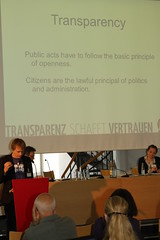
Daniel Lentfer presents the Transparency Law at the PEP-NET Summit 2012
Campaigners for a local transparency law, the so-called Transparenzgesetz, can look forward to a summer watching the football with a cool bottle of Astra and a Bratwurst. Expecting stiff resistance from the local authority, they had planned to spend the next few months preparing for the next round of a local citizen’s initiative, which would have required them to collect thousands of signatures in order to force a referendum. But to many people’s surprise, an adapted version of the law was passed last week.
Following negotiations with all parliamentary party groups and the campaign’s initiatiors (Mehr Demokratie, Transparency International and Chaos Computer Club), a text was agreed upon and passed on 12th June. By introducing an inventory of publicly held information, including data, and obliging public servants to open information by default, the law will go a long way to increasing transparency in the local authority. The types of information that are included in the duty to publish are, amongst others, contracts for public services, official statistics, geodata and spatial development plans. Where there are compelling reasons, such as data protection or the protection of sensitive business information, the duty does not apply.
This law supersedes the Freedom of Information Law, passed in 2009. Hamburg’s wide range of instruments for involving citizens extend from citizens’ initiatives on a local level to livestreaming parliamentary proceedings, via the online spatial planning consultation system that TuTech developed with the city. The Transparency Campaign and the Parliament are in agreement that Hamburg is set to become Germany’s most transparent state, its transparency capital. As far as I know, this is the best example of open data and transparency being pushed through by a civil society campaign.
Posted in News, open data, Trends | No Comments »
|
|
4. May 2012 – 10:58 by John Heaven (TuTech Innovation GmbH)
|
Hamburg will become the latest German city to publish government datasets online, with plans to launch an open data portal by the end of this year. Exactly which data will be released, and when, is still unclear.
Hamburg already publishes some data online and is planning to release more, according to the Senate’s (Hamburg’s Cabinet’s) answer to an enquiry from Hansjörg Schmidt, the SPD parliamentary group’s representative on media and online policy.
Schools performance data, information on cancer patients, air quality and water quality are all available online and in many cases downloadable in Excel format. I had a quick look through these websites and it does appear that information in Excel format is relatively easy to get at, although it is questionable whether this is really raw data since it is presented in a non-standard format and appears in some cases (for example the schools data) to have been pre-crunched. In the case of water data, making this data open is a technical challenge — at the moment, only a description of the data is available due to its size.
The city will also release geographic data at some point, including the location of play areas and police stations. There appears to be no promise that this will coincide with the launch of the portal and no cast-iron guarantees about exactly what data will be made available.
The Senate’s response does not make a clear commitment to launch a portal, but NDR reports that the City has officially announced its intention to do so by the end of the year.
Alongside talk of an open data portal, the campaign for a Transparency Law is making much greater demands. The backers of the law want to go much further and are pushing for a law that will oblige the local government to open all of its data unless there is a compelling reason not to do so. A comment on Hansjörg Schmidt’s blog suggest that some backers of the Transparency Law may see this as an attempt to diffuse their campaign by opening some data. I am sure this will be a hot topic at the next Open Government Stammtisch on 9th May and the PEP-NET Summit on 14th May.
Posted in open data | No Comments »
|
|
23. February 2012 – 15:54 by John Heaven (TuTech Innovation GmbH)
|
Mehr Demokratie e.V., Transparency International and the Chaos Computer Club are campaigning for the adoption of a local law that would give Hamburg citizens and charitable organisations enhanced access to previously confidential information. Daniel Lentfer from Mehr Demokratie, a not-for-profit organisation that campaigns for more direct democracy in German politics, will present the Transparenzgesetz at the PEP-NET Summit on 14th May.
The proposed transparency law was drafted using a wiki, which was open for anyone who wanted to to participate. It calls for a central information register, listing all of the city’s official publications; a duty to publish, which includes public data; and the extension of the right to information to voluntary organisations, especially campaigning organisations and not merely private individuals.
The campaign argues that such a law would reduce corruption, reduce wasting of taxpayers’ money, increase trust in politicians and the local authority, simplify administrative procedures and make participation easier.
Mehr Demokratie e.V. successfully collected the 10,000 valid signatures required for a local Citizens’ Initiative and the state parliament’s judicial affairs committee will decide whether to accept the law on 28th February. Mehr Demokratie is preparing for it to be rejected, in which case they will have to collect a total of 62,000 valid signatures within three weeks to force a local referendum.
Posted in Events, News, open data, Trends | No Comments »
 |
14. November 2011 – 23:06 by Asociacion Ciudades Kyosei / Pedro Prieto-Martin
|
The Asociación Ciudades Kyosei is a small civic organization whose aim is to foster Civic Engagement by means of ICT. It was founded in 2006 and is the oldest Spanish NGO devoted to the promotion of (e)Participation. In the last years we were researching on the field of Civic Engagement and ICT, with a special focus on Latin-America and Europe. Our work combines a critical attitude with an applied, hands-on focus, and has (1) theorized about Civic Engagement, (2) analysed the best design practices for (e)Participation systems, as well as (3) analysed the difficulties that exist to promote innovation in the ICT for Governance field. Our research has been widely recognized as refreshing and insightful.
In this PeP-NET post we would like to share a tool we have developed, “The matrix of civic implication”, whose main aim is to support the development of conceptual clarity when analyzing participatory venues and participatory initiatives. If used wisely, we think the matrix is a powerful “tool”, that goes beyond alternative models (like OECD, IAP2 or Fung’s), and should allow researchers, practitioners and the ‘man in the street’ to better understand the core dimensions of participatory activities.
The Matrix of Civic Implication
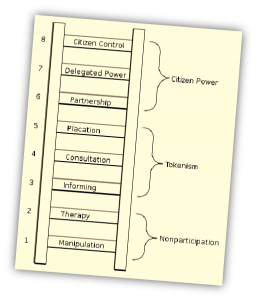 Since Sherry Arnstein presented her “Ladder of Citizen Participation” in 1969, tens of models have been proposed with the aim to describe “participation”.
The problem with these models is that they tend to be either too basic -and thus they add less value- or they are too complex and specialized, and in this case they are too cumbersome to be applied.
For this reason… a lot of confusion exist in this field.
Our matrix tries to find a pragmatic balance between usefulness and complexity, and provide a tool that is at the same time powerful, practical and easy to use. It allows practitioners and theorists to compare in a matter of minutes different Participatory experiences. The model was developed to be applied to “municipal participation” initiatives, but it can be applied to other kind of participatory experiences.
The Matrix identifies four fundamental dimensions of participatory initiatives, which be informally “visualized”, and thus make this model especially suitable for comparing initiatives:
Read the rest of this entry »
Posted in open data, Tools, Visions | 1 Comment »
|
|
6. October 2011 – 18:31 by John Heaven (TuTech Innovation GmbH)
|
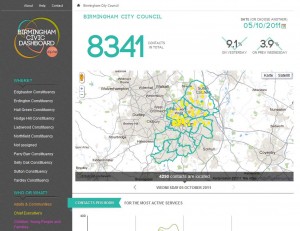
Birmingham Civic Dashboard screenshot
In its recent consultation document ‘Making Open Data Real’, the UK Government expresses high hopes for open data, heralding it as possibly “the most powerful lever of 21st century public policy”. Following several years of open data advocacy, activism and hack days, in the UK open data is moving towards the mainstream thanks to unanimous backing from the coalition government and the opposition.
The latest move in open data comes from Birmingham City Council, which today launched its ‘Civic Dashboard’. This is a web site publishing raw customer services data along with a slick visualisation, which was made possible by a grant that Digital Birmingham received as a result of winning a competition run by the National Endowment for Science, Technology and the Arts (NESTA).
The Civic Dashboard draws its data from the customer service centre set up as part of the Council’s Business Transformation programme. An extract of data about all customer enquiries, whether by telephone, internet or email, is recorded by the customer relationship management system and fed into the Civic Dashboard in an aggregated (anonymised) form once per day. Where the data is geocoded, it can be presented on a map to show how many contacts originate from a particular ward or constituency. You can even see which channels the enquiries come through, which shows that the Council receives far more enquiries by telephone than through other channels.
This is an important step towards bridging the gap between eGovernment and ‘weGovernment’. Coming from the Council that was heavily criticised for spending £2.8m on its website as part of its eGovernment transformation, especially by Birmingham’s vocal social media users, opening up the data that is produced in the background shows what the new infrastructure can do beyond serving up static content. Doubtless there are many more datasets that exist as a result of the transformation programme, and if these are released in the future, perhaps Brummies will feel they got a better deal out of transformation than they first thought.
This itself is quite a paradox: such a handover of control to the citizen wouldn’t have happened if it weren’t for the huge transformation programme because IT is absolutely necessary for the collection of data in a reusable form.
Read the rest of this entry »
Posted in good practice, News, open data, Trends | 1 Comment »
|
|
26. September 2011 – 13:52 by John Heaven (TuTech Innovation GmbH)
|
e.gov conference, Belfast
At the “Open.gov & e-participation” conference in Belfast on 22nd September I said a few off-the-cuff words about open data in Germany before presenting DEMOS-Plan, the spatial planning consultation software that we have developed together with the local authority in Hamburg.
I think it’s fair to say that the open data debate is not quite as far ahead in Germany as it is in the UK. Although there are good examples (MOGDy, Apps4Berlin, Berlin’s new open data portal, the Bremen open data recommendation) here of local authorities and third parties opening their data and demonstrating what they can do, the UK government’s commitment to opening data as demonstrated by data.gov.uk and its recent consultation on ‘Making Open Data Real‘ show that the debate has moved on from ‘whether’ to ‘how’.
However, I argued, based on experience of eParticipation more generally, when Germany does catch up it will commit to well thought-out solutions that are implemented sustainably. The examples I used were Hamburg’s social media guidelines — which I have previously mentioned on PEP-NET and which describe in detail how Hamburg handles social media — and our own DEMOS-Plan, which is fully integrated into Hamburg’s infrastructure, is ‘business as usual’ because it will from now on be used for all local plan consultations in Hamburg, and is backed up by a procedure that gives citizens and stakeholder organisations a legal right to participate in urban planning, both online and offline.
If things happen in a similar way, I think open data will take off in Germany and many of the same issues that the UK is wrestling with will apply: so it will be necessary to think about the costs of opening datasets and to decide on which ones have priority. How do you decide which datasets are worth the investment? Do you assume that businesses will be built on the data public bodies publish, or do you prescribe a specific purpose that data should be used for? The UK government is quite clear in its white paper that enabling service users to make a more informed choice about which providers they use is an important motivation.
One issue that I think will be get more attention in Germany than in the UK is data protection. You get a good idea of how jealously Germans guard their privacy if you have a look around a residential area with Google Street View — in some cases, so many houses are blurred out that it is pretty much useless. Or see the Unabhängiges Landeszentrum für Datenschutz Schleswig-Holstein’s (Data-protection Commission for the State of Schleswig-Holstein’s) decision that Facebook pages and ‘like’ buttons on third-party websites contravene data protection law and should be stopped with immediate effect. In this context, I find it difficult to foresee Germany adopting an ‘open by default’ policy with regards to data. The risk that personal data could slip through the net could be too high.
So I think the German public sector is working on these issues and when the strategy is nailed down, it will be embedded for the long term. In short, open data will at some point be business as usual, even if it Germany doesn’t do ‘open by default’.
Posted in open data, Trends | 1 Comment »
 |
23. August 2011 – 16:48 by Rolf Luehrs
|
The European Comission published a call for tender to implement an European Commission Open Data Portal.
The purpose of this tender is the purchase of services:
- to develop and administer a web portal to act as single point of access to data sets produced and held by European Commission services (and by extension to data sets produced and held by other European Institutions/bodies and other public bodies);
- to assist the Commission with the definition and implementation of a data set publication process;
- to assist the Commission with the preparation of data sets for publication via the portal;
- to assist the Commission in supporting for engaging the stakeholders’ community interested in re-using the published data sets.
Deadline: September 19th. For detailed information see : https://ec.europa.eu/information_society/policy/psi/open_data/call_tenders/index_en.htm
Posted in calls & tender, open data | No Comments »
|
|
23. August 2011 – 16:28 by John Heaven (TuTech Innovation GmbH)
|
 I just stumbled across the UK Government’s Open Public Services white paper from July, which outlines the Government’s plans for reforming public services to make them more efficient and bring them closer to citizens.
A short section is dedicated to the role of open data in public services (page 19, or page 21 of the PDF). Under the heading “Using data to support choice”, the primary role for open data in this paper is allowing people to compare services and enable them to make a choice on which of them to use.
On top of that, the paper mentions a “right to data”, but this appears to be limited to existing datasets that already exist in electronic form — “… when useable datasets about public service performance and funding are not being published …”. This is reinforced by the phrasing of the commitment “… we will ensure that the datasets government collects are open and accessible …”
There will be some movement on the datasets that are collected, which the paper argues should reflect the wishes of service users, i.e. the kind of information that they would wish to base their decisions on. As the paper rightly flags up, there is an issue about whether to require public sector organisations to collect standardised information, which would mean less influence for individuals but greater comparability, or allow more account to be taken of local needs.
Reading (this part of) the paper, it becomes clear that the devil is in the detail of open data: how to decide which datasets to invest money in collecting? How to respect user choice whilst maintaining comparability? And how to avoid making the whole thing hugely bureaucratic? With all the talk of more choice, meaning different service providers for the same service, and the necessity to collect data for each of these service providers to enable comparisons, there is actually another layer of granularity that the regime of National Indicators for measuring local areas’ performance didn’t require.
Posted in News, open data | No Comments »
 |
17. May 2011 – 10:30 by openaid
|
Can e-participation help to reduce poverty in Africa? Is it a suitable tool to improve the effectiveness of aid projects and to reduce corruption in the aid business? These questions may surprise you, as PEPNET is a network of organisations and individuals working in Europe and even in Europe it is challenging to design well-functioning e-participation processes. OpenAid has been a member of PepNet for a few months and I would like to make our long-overdue self-introduction by describing our vision of e-participation in development cooperation.
OpenAid is a small association based in Germany and our background is evaluation of development projects. Traditionally, funding organisations, like the German ministry for economic development and cooperation (BMZ) commissions experts to visit projects, e.g. in Africa and assess these projects based on predefined criteria. While this type of project evaluation a very dominant feature of the development business, it has only limited value. In an evaluation, for example of a water project in Southern Cameroon, only the questions that are most interesting to the donors in Germany and to the project managers get asked. Concerns that people living in the project areas may have will not be addressed, if the project management is not aware of them or does not want to address them.
In addition, most citizens in a project area are not able to talk to the evaluators, due to the tight time schedule of evaluations, distances in the project area and language barriers. Providing feedback about a project on a regular basis is close to impossible.
We at OpenAid are convinced, that this lack of feedback in aid projects is a big problem, and we think that advances in technology and social media can help to fix the feedback loop. This is where we why we are interested in experiences about e-participation in Europe. What are the lessons learnt in Western Countries about the conditions for successful e-participation? And which of these lessons are applicable to development cooperation?
We call our e-participation project public online monitoring of development aid. In our thinking there are several elements to public online monitoring:
1) General information about aid projects: The more information and the more open the information, the better. This strand of our work links us to the open data movement. International development cooperation has been very slow to provide information in accessible format to a wider public. But currently the aid transparency debate and open data initiatives in development cooperation are gaining momentum. OpenAid has been promoting aid transparency, and particularly the International Aid Transparency Initiative (IATI) since 2009. We are currently organising a major open aid data event in Berlin for September 2011.
2) Mobile Technology and Connectivity: Costs for providing and distributing information to a large audience have plummeted due to the advances of technology in recent years. Of course, in many rural areas of Africa, Asia and Latin America, good internet connections are not self-evident. But mobile services can substitute regular internet connections to a certain degree. This is why we are very interested in the creative use of SMS and other mobile applications. For the time being it is also possible to experiment with public online monitoring in urban areas e.g. in Africa that have good internet access. We are convinced that access to the internet in rural areas will continue spread in the coming years.
3) Online communities: Where should people go to provide feedback about a water project, about a health clinic or about a school feeding programme? Where is the virtual comments box for aid projects? One option would be for large aid projects to set up their own online community. But it will probably be difficult to generate enough among citizens living in the project area and other concerned people to bring such a community to life. This is why we propose to use existing social networks, where people already connect, to monitor projects that interest them. Traditionally these social networks were community meetings e.g. in churches and mosques. Today, social media networks can complement offline communities. So, we have in mind to “project groups” on social media networks like Facebook. On the one hand Facebook has a fast growing number of users in e.g. development countries. On the other hand, however, the criticism about Facebook is increasing and other social media networks may be more appropriate.
In our advocacy work on aid transparency we have seen, that migrants from Africa, Asia and Latin America tend to have a strong distrust of the aid system and strong feelings about misuse of funds in development cooperation. Therefore we are currently exploring possibilities to cooperate with migrant communities in Germany to build online communities around individual projects or around development cooperation going to geographically limited areas.
Other possible drivers of online communities are donors themselves. The example of AKVO in the Netherlands demonstrates, that even governmental aid agencies are recognising the value of collecting public feedback on projects via the internet. We are hoping that other donors will follow the same path.
4) Choice of projects: Finally, we are convinced that not all aid projects are amenable to public online monitoring. Projects targeted at young, urban, educated people are probably more suitable then projects targeted at elderly, rural, illiterate citizens. Projects delivering direct services like health programmes or water projects will probably attract more interest then projects focused on administrative reforms in ministries or projects targeted small minorities in the population.
Until now, OpenAid has been active on the precondition of public online monitoring: access to open data on aid activities. We are just taking the first steps to make public online monitoring a reality. We hope that successes and failures of e-participation in Europe will help us make good choices in this process and hope to be able to share our experiences with member of PEPNET in the future. If you have any comments on our concept so far or if your organisation is interested in collaborating on this project, please contact me under claudia.schwegmann@openaid.de!
Posted in members, open data, Projects, Visions | No Comments »