Avatar of nadine

(Research) conferences about eParticipation & Youth: an overview for 2013

20. March 2013 – 17:01 by nadine

Also in 2013, there will be some good occasions to exchange about eParticipation & youth, in particular from a research perspective. The benefits for participants is obvious: next to updates about important and relevant developments in the field of eParticipation, participants value the inspiration for upcoming trends, high-class keynote speeches and the possibility to network and get together. As a side effect new project ideas are born – another good reason to attend such conferences.


We have pulled together a small overview about relevant research conferences for 2013. For further, detailed information about the below mentioned conferences please browse the link under each paragraph (e.g. conference fee, registration). The overview below is not complete, hence if you do find another conference worth to mention, please add a comment and a link, if available.


Youth 2.0: Connecting, Sharing and Empowering? Affordances, Uses and Risks of Social Media

March, 20-22 | Antwerp, Belgium | Working language: English

The call for papers ended end of November last year, thus, the final program is in process.

The conference focuses on the themes of identity construction, social relations, interests at stake, supporting and empowering.

Within the strand of interest at stake, the question is included, how young people can be mobilized through social media. The concrete design of this thematic strand will be answered once the final program is published. In particular to what extant eParticipation is addressed concretely.

Further information: http://www.ucsia.org/main.aspx?c=*UCSIAENG2&n=108874&ct=108874


Youth and Civic Participation. Is a Younger Generation Reshaping European Politics?

May, 15-17 | Antwerp, Belgium | Working language: English

The UCSIA devotes a whole conference to the topic of youth and digital participation. The call for papers has ended end of January. Overall, the conference addresses four key themes: Motives and values that inspire youth to engage, Old and new behaviour of civic participation, Context and skills that condition youth civic participation, Impact and influence of youth civic participation on contemporary politics.

Further information: http://www.ucsia.org/main.aspx?c=*UCSIAENG2&n=110394


Cedem – International Conference for E-Democracy and Open Government 2013

May, 21-23 | Krems, Austria | Working language: English

Till February 5th interested ones in this conference could use the chance to submit a paper or a workshop proposal within the call for papers.

The conference offers a great variety of thematic tracks related to current questions: E-Democracy and E-Participation, Open Collaborative Government,

E-Policies and E-Society – Human Rights for the Internet Age, Social and Mobile Media for Public Administration, E-Campaigning & E-Politics,

Bottom-Up Movements, Open Data, Transparency and Open Innovation, Open Science and Open Access, Freedom and Ethics in Digital Societies.

In what extant eParticipation and youth will be addressed, the final program will show, once it is published.

Further informationen: http://www.donau-uni.ac.at/en/department/gpa/telematik/edemocracy-conference/edem/vid/18671/index.php?URL=%2Fen%2Fdepartment%2Fgpa%2Ftelematik%2Fedemocracy-conference%2F18671


12th Nordic Youth Research Symposium (NYRIS) – Changing societies and cultures: Youth in the digital age

June, 12-14 | Tallinn, Estonia | Working language: English

The call for papers ended these days on January 31st, thus, the next step towards the final program is in progress. The conference addresses in general the challenges of the digital change from a youth perspective. Overall, the organisers offer 30 sessions in 16 streams, displaying a large variety of topics such as, youth participation and political activities, online youth activism, youth and digital games, youth and online identities, as well as youth and media.

Further information: http://www.tlu.ee/?LangID=2&CatID=5995


12. eGOV & 4.ePART

September, 16-19 | Koblenz, Germany | Working language: English

Within the 12th eGOV conference, the 4th edition of ePART takes place as an own thematic track. The deadline for contributions, such as papers, is March 15. For workshop proposals and panels counts a different deadline for which it is advisable to browse the conference website regularly, to be up to date about it.

In 2012 some new relevant insights about eParticipation and youth could be presented, let’s see for 2013 edition.

Further information: http://www.epart-conference.org  


Some further inspiration can be found in the blog post from Tim Bonnemann (@planspark) from Intellitics, providing additional information on conferences in Northern America, for example.

Avatar of Rolf Luehrs

CeDEM13 Call Extended: New Deadline 5 February 2013

16. January 2013 – 10:28 by Rolf Luehrs

Call Text from Noella Edelmann and Peter Parycek (Conference Chairs):

We kindly invite you to submit a paper to this year*s CeDEM – Conference for E-Democracy and Open Government. The conference will be held in Krems, Austria, 22-23 May 2013. The submission deadline has been extended to 5 February 2013.

In 2013, the CeDEM13 will focus on E-Democracy and Open Government in the context of human rights and freedom in a digital society and covers the following topics: E-Democracy, E Participation, Government 2.0, Social Media and Public Administration, E Politics and E Campaigning, European Citizen Initiative, Participatory Budgeting, Bottom Up Movements, Open Data, Open Innovation, Open Science and Open Access.

Keynotes at the CeDEM13 will include John Carlo Bertot from the University of Maryland, Karine Nahon from the University of Washington, Beth Noveck from the New York Law School and former United States Deputy Chief Technology Officer for Open Government, and Tiago Peixoto from the World Bank, Washington.

Conference website: www.donau-uni.ac.at/cedem

Submission site: www.cedem-conference.org/cedem13

Follow us on Facebook: http://tinyurl.com/CeDEMfacebook

Avatar of Zebralog

Call for participation: Workshop on Argumentation Technology for Policy Deliberation (IMPACT project)

27. November 2012 – 13:32 by Zebralog


/Please note: This post is not from Hans Hagedorn, but from Steffen Albrecht @ Zebralog…/

In conjunction with the 25th International Conference on Legal Knowledge and Information Systems (JURIX 2012, Amsterdam, 17-20 December 2012), the Workshop on Argumentation Technology for Policy Deliberation will present the results of the European FP7 IMPACT Project, along with invited talks by leading developers and users of argumentation tools for supporting public participation in policy deliberations on the World-Wide-Web.

The workshop will take place on Monday, December 17, at the University of Amsterdam.

For information about the workshop program and organizational details, please consult the JURIX website. Looking forward to seeing you in Amsterdam!

Avatar of nadine

#ePART12 – Learnings from an international research conference about eParticipation

10. October 2012 – 11:52 by nadine

From November 3rd till 6th, ePART took place in Kristiansand, Norway. It has been the 4th research conference of this kind which takes place as a separate track within the EGOV research conference. The EGOV conferences are organized by the IFIP Working Group 8.5 and in 2012 the 11th conference took place.
ePART is a place where people exchange latest research results, network, foster and establish cooperation between researchers and practitioners from the field of e-participation, and identify future trends.
ePART is a rather small research conference, in total the city of Kristiansand and the University of Agder welcomed around 100 participants including speakers and moderators.

Within the project, youthpart will be able to pile up some insights regarding relevant questions about youth & e-participation and young people’s participation in the digital society. These findings but also technical innovations may be interesting for a forum such as ePART as well.
Among the 18 research presentations, 2 key notes and 2 workshops, the following four projects attracted youthpart’s attention:


  • Getting Teenagers to participate: a case study from the city of Lausanne
  • Choosing the Right Medium for Municipal eParticipation
  • Online Communities Support Policy-Making: The need for Data Analysis
  • Public Policy Formulation through Non Moderated Crowdsourcing in Social Media


Getting Teenagers to participate: a case study from the city of Lausanne

Getting Teenager to participate – that was the focus of the scientific analysis presented by a representative of the University of Lausanne. The task proofed to be challenging: the city of Lausanne decided to establish a youth council and in order to attract applications for it, the decision was made for a two folded campaign, using online (e.g. facebook, youtube) and offline media (e.g. posters). For the design and implementation a media agency was contracted. The (failed) campaign was evaluated by the University of Lausanne and the Graduate School of Public Administration and showed how difficult it is in fact to motivate young people to participate in political engagement beyond organized structures. Yet, some interesting findings from the motivated youngster who handed in an application suggest that various factors contribute to becoming active as a young person, such as idealism to improve the world, political discussions with parents or active members of the family who serve as example, previous (voluntary) experiences.


Choosing the Right Medium for Municipal eParticipation

Researchers from the University of Agder put the relationship between media preferences, the need for information and local participation in the centre of their research. They chose an 8,000 inhabitant village and first identified the different target groups (e.g. business, youth, immigrants, seniors) and asked them about their media preferences and information need.  According to the data, young people voice a need for general information, local information, individual information, and in addition are interested in a service dialogue as well as a service to report infrastructure problems. For all these information needs, the figures show that internet based communication services are in the lead, especially websites and email. Social media services unfold their strengths when it comes to the specific information need “forum for discussion” and “dialog among business” whereas mobile media peak when it comes to reporting infrastructure problems.


Online Communities Support Policy-Making: The need for Data Analysis

Using swarm intelligence to support policy making still has its perils when it comes to text-based online discussions: finding the key arguments and their benchmark within a reasonable time span proofs to be difficult. There is a need for data analysis based on a technical approach says a representative of the Fraunhofer Institute. The software presented manages to analyse long thematic threads according to different criteria: words are clustered based on their frequency and the user just needs to define the name of that specific cluster then. Additionally, the tendency of clustered text can be displayed which allows to identify positive and negative arguments and their strength. One important aspect is the setting of the discussion meaning that users know about the purpose of the online-platform, the topic, relevant questions and who set it up; that only allows users to make conscious contributions.


Public Policy Formulation through Non Moderated Crowdsourcing in Social Media

The presentation of a European research project lead to some controversial discussion among the audience: the consortium presented the idea to develop crawler software that searches social media, collect postings, analyse them and offer them to support policy making. The consortium calls it non-moderated crowdsourcing in social media, while the audience is reminded about surveillance mechanisms. Representatives of the project argue that social media are public sources of information, similar to online newspapers, and therefore could be used easily for policy making purposes. A listener from the audience refers to ministries who use exactly the same argument to watch online activities of their citizens, for surveillance purposes. The discussion showed that this project works at the brim of the notion of e-participation.


ePART and EGOV conferences benefit from their international audience; not only through the contribution of European participants, but to a great extant through participants from around the globe, such as Mexico, Indonesia, the United States of America, Brasilia, Cameroon, India and South Korea. ePART’s fifth edition will take place from September 16-19, 2013 in Koblenz, Germany, jointly with the 12th EGOV conference.


For more information about the conferences browse http://www.epart-conference.org/

Avatar of John Heaven (TuTech Innovation GmbH)

Calls for transparency around German MPs’ extra earnings; Hamburg Transparency Law enters into force

8. October 2012 – 17:33 by John Heaven (TuTech Innovation GmbH)

It was all about transparency this weekend in Germany, and here’s why.

German’s largest opposition party, the SPD, has finally decided who their candidate for Chancellor will be at the next elections – and already he is getting into problems due to paid speaking engagements during his time as a Member of Parliament.

Peer Steinbrück stands accused of neglecting his job as an MP and of potential bias in favour of banks that paid him for speaking engagements. He has responded by denying the allegations and promising to publish details of how much he received from whom, and what topic he spoke on, and calling for more transparency around German MPs’ earnings gained from second jobs. Having said that, he asserts that “transparency only exists in dictatorships.”

Abgeordnetenwatch, a German website similar to TheyWorkForYou.com operated from Hamburg, has weighed in on the argument. Their founder, Gregor Hackmack, called Steinbrück “a black sheep” amongst MPs: “There is a small number of MPs – Peer Steinbrück, Michael Glos or Heinz Riesenhuber – who have earned a particularly high amount alongside their work as an MP and are neglecting their duties,” presumably calling upon figures gathered through Abgeordnetenwatch. This episode could be a boost for the transparency agenda in a similar way to the MPs expense affair in Britain.

Abgeordnetenwatch was also in the headlines over the weekend because the Hamburg Transparency Law entered into force. Along with other campaigners (Mehr Demokratie e.V., Chaos Computer Club, Transparency International) who successfully forced it through, Abgeordnetenwatch celebrated the entering into force of the Hamburg Transparency Law on Saturday. As I wrote previously, the law was suddenly and surprisingly adopted back in June and requires a greater level of transparency by default, including the creation of an information register.

At the event on Saturday, held at Kultwerk West, the portal “Frag Den Staat” was made available to users in Hamburg to coincide with the transparency law. Similar to the UK’s “what do they know”, the website allows citizens to make freedom of information requests in public and post the responses to the website. Ideas for information requests were collected from the audience and some requests were made in order to demonstrate to the audience how the website works.

In the name of transparency, I suppose I should mention that I’m an unpaid team member at Kultwerk West, where the event was hosted.

Avatar of John Heaven (TuTech Innovation GmbH)

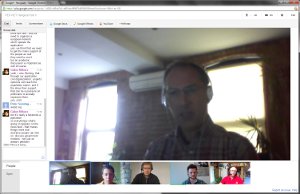
It’s the taking part that counts, not the minutes – PEP-NET Hangout

28. September 2012 – 15:25 by John Heaven (TuTech Innovation GmbH)
Picture of PEP-NET Hangout

The invisible man

Today we held the second of two Google+ Hangouts with PEP-NET members. No real agenda, open to anyone who was interested, and not quite sure whether it would work. We gave it a go.

From an organiser’s point of view, the best things about doing a hangout rather than a text-based live chat (as we have done before with CoverItLive) is that i) the number of participants doesn’t need to be high for you to feel successful and ii) you can really see who is there and know that people were there for the duration. If I had organised a live text chat and six people in total had taken part, I would have been pretty disappointed.

Rather than writing boring minutes of the conversation, here is a collection of links to projects that were mentioned, as well as the websites or twitter accounts of the participants themselves. After all, it’s the taking part that counts, not the minutes.

Finland: Youth Initiative Channel, a project allowing youngsters to make suggestions/express wishes. Similar to FixMyStreet but about solutions, not problems.
(Some information in 2.3.1. of this report (PDF)), via @nadinekarbach.

Iceland: A group of citizens drafted a new constitution using online collaboration tools and presented it to the speaker of the parliament. Here’s a link that I found about the story, via @nadinekarbach (again)

Finland: The Finnish children’s parliament, via @nadinekarbach. (Now I feel like a kid copying someone else’s homework. Thanks Nadine.)

UK: 38 Degrees: a platform that brings people together to campaign, via @andywilliamson

The Danish Parliament puts videos of all its sessions online, and has made them fully searchable by users. Here’s an article I found about that. Thanks again, @andywilliamson

Participants:
Gábor Mihucz (Foundation for Societal Participation, Germany/Hungary), @GaborMihucz
Nadine Karbach (YouthPart, Germany), @nadinekarbach
Andy Williamson (FutureDigital, UK/worldwide), @Andy_Williamson
Hans Hagedorn (DEMOS eParticipation, Germany), @haans_en
Rolf Lührs (TuTech/DEMOS eParticipation, Germany), @somed
Peter Sonntagbauer (FUPOL), fupol.eu
… and of course me, @johnheaven
And PEP-NET is @pepnet.

Avatar of John Heaven (TuTech Innovation GmbH)

Date and time for PEP-NET Google+ Hangouts

24. September 2012 – 16:41 by John Heaven (TuTech Innovation GmbH)

Last week I suggested we arrange a Google+ Hangout to catch up with each other, especially as we have some new members. Well we had quite a lot of interest, so I decided to hold two hangouts.

I have already written to those whose email address I have, so anybody else please note the following two times:

Hangout I: 27/9 at 15.00

Hangout II: 28/9 at 11.00

All times are CET. Please add me to a Google+ circle so that I am able to find you quickly and can invite you to the hangout.

I look forward to catching up with you!

Avatar of John Heaven (TuTech Innovation GmbH)

And the most innovative e-government project in the German speaking world is …

17. September 2012 – 13:49 by John Heaven (TuTech Innovation GmbH)

Every year, Bearing Point and Cisco Germany award a project the title of “the most innovative e-government project in the German-speaking world”. This year, the Federal State of Schleswig-Holstein was nominated for their project BOB-SH* in which they implemented DEMOS-Plan, our software for managing spatial planning consultations online. And they won!

So we’ve been feeling a little bit innovative for the past week too. After all, we worked closely with Schleswig-Holstein, giving technical support, training and telephone assistance to the wide range of stakeholders who will be working with DEMOS-Plan.

DEMOS-Plan is an online tool that closely follows the procedure laid down by German law for conducting consultations on a particular type of spatial plan (the “Bebauungsplan”). It allows statutory stakeholders to manage submissions internally by requiring one representative to sign off the submissions from different departments. These submissions can be linked to a particular paragraph of the planning document and/or the participant can draw on a map of the plan.

It’s great for the planning authority, because it saves them the trouble of sending paper copies of plans and collating all the submissions manually: instead, this is done automatically.

We think there are other countries in Europe where DEMOS-Plan could be useful and have been investigating this through the Parterre project. If you were at the PEP-NET Summit, you may have caught Francesco Molinari’s presentation of Parterre. (Hopefully you will also have noticed that the Summit was sponsored by Parterre!)

There will be more news on Parterre soon, so keep your eyes on the blog!

* Bauleitplanung Online-Beteiligung Schleswig Holstein

Avatar of John Heaven (TuTech Innovation GmbH)

PEP-NET Hangout – catch up on who’s doing what

14. September 2012 – 16:20 by John Heaven (TuTech Innovation GmbH)

Several new members have joined PEP-NET recently (see our members page), mainly thanks to the publicity around the PEP-NET Summit in May. I thought it would be a nice time to catch up again and meet the new members. We can’t organise a conference as often as we might like, but we can use Google+ Hangouts to keep in touch.

So if you are interested, fill in this Doodle poll to let me know when you can take part and I’ll publicise the date and time when it’s been decided. I’m hoping to keep it simple, with a quick round-robin of introductions and updates on what people are doing, and then discussion about conferences that people are planning to go to (hopefully people will be able to take the opportunity to meet up with one another in person), and then general chatter about recent developments and co-operations.

Looking forward to chatting!

Avatar of gabor

In response to Anthony Zacharzewski

2. September 2012 – 12:34 by gabor

A couple of weeks ago, Anthony Zacharzewski, social activist of The Democratic Society wrote a review on our association’s project that had the working title ‘webvotr’ and has since been named Civilzone.

We very much appreciate any feedback regarding the site and any comments would be greatly appreciated. Besides highlighting the elements of the initiative that he found most appealing and wishing us success, Anthony also raised a few interesting questions and pointed out some risky areas where we might not reach our original goals.

He suggested three possible problems.

Civilzone openly aims to mobilize society on international, national and at local government levels – Anthony thinks that in small local communities the so-called “Empty Restaurant Syndrome” might occur; due to the lack of users and interaction, the number of people joining smaller governmental units will not be enough to form a community able to make real changes and decisions. As an example, he quoted iCan, BBC’s similar project from ten years ago.

Although his worries are reasonable, I think this does not represent a real danger for us: there are two reasons why.

One of them is that while BBC forcefully tried to organise every single parish’s government from above, our scenario is completely different; we’ll try to begin organising the groups of administrators running the application on national level in as many countries as possible.

The administrators will post the parliamentary initiatives, then first the opponents are expected to demonstrate their dislike, and the ones in favour of the initiative will then show their support in reply to the negative arguments. Subsequently, there will hopefully be individual initiatives and perhaps success stories too, similarly to Hamburg’s Transparency Law.

Smaller communities will only be formed after this, as need for them emerges. As soon as we have at least one or two people willing to organise a community, they will be granted the opportunity from the administrators moderating the particular administrative area. By this time, results achieved on national and EU-levels will be the inspiration for many.

The other reason is that internet today is very different from what it used to be 10 years ago: not only regarding the number of users but also in terms of the transmission speed of information.

BBC’s iCan drew attention to the application but failed to generate activity. Even if a few individuals were determined to convince their friends and acquaintances of joining they could only attempt to do this through email and in person. Today the social network is a very active place where using the network of connections, clearly demonstrating the principle of 6-7 steps, the right information can spread on a global scale in seconds. Every comment left and every vote cast on civilzone will appear on the user’s Facebook wall, visible to all his friends, allowing societal participation to go viral.

I find the second query to be the most interesting: Anthony says that online experience so far has shown that only people from “the same side” can effectively cooperate on political matters. Besides many great examples, I can also point out current Hungarian ones: on Facebook, pages having around a hundred thousand likes, like One Million Strong for the Freedom of Press in Hungary or Viktor Orbán’s, it is clear that only people belonging to the same side can get along well. If every once in a while someone from “the other side” comes over, they either only want to disrupt the community, or if they’re actually trying to reason together or make a consensus, some keen users from the original community will make it clear with their atrocious comments that there’s no room for them here.

The difference for us lies in the fact that on civilzone we’ll have specific issues and initiatives that affect the lives of the people who live in the civil parishes rather than pages of organisations, parties and movements. So I hope that instead of supporting parties and taking sides, the discussion will focus on how much passing or rejecting a particular initiative can serve the interest of the community.

In order to promote this, we incorporated two features into the application: firstly, displaying the most popular pro and con arguments; secondly, the possibility of sending in articles or blog posts.

The third argument to be considered is the following: “How can it represent those offline, and how can it avoid just giving a stronger voice to those who (through education, wealth or position) already have a strong voice?”

Perhaps this is the area where we have the biggest cultural difference: in Hungary, besides online newspapers and weekly prints, there is only one radio station and one television channel that clearly voice the left wing’s standpoint – in opposition since 2010 – but even these are experiencing various difficulties. The internet on the other hand is widely known as a source of objective information and a means of taking a clear look at both sides of the coin. With regard to the above, the application would actually amplify the voice of those who are now in minority besides the crowds who voted the present government into constitutional supermajority.

Freedom of press is of course a separate issue; the parallelism here is not entirely correct.

I think that Anthony’s following query is the most relevant: it is true that those without internet access will not have a chance to effectively represent their interest through the application. Even though the growth is unstoppable and 92.9% of Sweden’s, 84.1% of the UK’s and 82.7% of Germany’s population are already able to access the World Wide Web, the figures quoted still do not make up 100%.

One possible solution is to use the application to demonstrate even more clearly that in an information society, internet access should be a universal human right – numerous countries (Estonia, Finland, France, Spain and Greece) have succeeded in implementing this. Civilzone could provide a way to start a petition in the European Union and it could be a useful, influential tool in shaping politics and the public opinion even for those wanting to help people living on the edge of the society.

In my personal opinion, the most challenging part of the project is building an international network. Even though I don’t have years of experience in this field I can see that in the case of e-participation or at least in organising activism through the internet, civilians – especially the younger members of the Y and the almost grown-up members of the Z-generation – are more successful than civil activists and also that thinking and keeping in touch on European or global level is quite rare.

It is very fortunate that organizations like PEP-NET and Participedia exist and improve the situation greatly, allowing us to write to you here, but I think more activity, discussions, statements, petitions and demonstrations, all in all, more participation is required to achieve our common goals.

Because of this, I’d like to ask everyone to write if they feel like they have something to comment about the present or the previous article; let’s ease the burden on John Heaven’s shoulders a little!

If you prefer paying attention from the background, I’d like to recommend Anthony’s organization and also our organization.

Let’s do some networking.